The enterprise technology landscape stands at an inflection point where the distinction between AI Agents vs AI Assistants represents far more than a semantic difference—it signals a fundamental restructuring of how work itself gets done. For years, organizations have pursued digital transformation through automation and analytics, accelerating processes and integrating systems while one structural challenge remained stubbornly persistent: humans still carried the burden of coordination, moving information between disconnected systems, following up on stalled workflows, reconciling mismatched records, and absorbing operational friction across departmental boundaries. That pattern is now changing as we enter the era of agentic business transformation, where autonomous AI systems do not merely support people but participate directly in execution, closing operational loops end-to-end rather than simply suggesting the next action. The conversation around AI Agents vs AI Assistants is pivotal in this transition.
This shift extends far beyond conversational interfaces or productivity tools. It represents a redesign of how operational responsibility is distributed inside the enterprise, moving from augmentation to automation, from copilots to coworkers. While AI assistants like ChatGPT or Microsoft Copilot wait for instructions and provide single-step outputs, AI agents proactively pursue goals, orchestrate tools, and complete complex business processes with minimal human intervention. The market trajectory confirms this inflection point with striking clarity—the AI agents market is projected to explode from $7.84 billion in 2025 to $52.62 billion by 2030, registering a compound annual growth rate of 46.3%. By late 2025, over 60% of Fortune 500 companies had already deployed multi-agent systems for operational automation. Yet confusion persists as vendors engage in “agent washing,” rebranding basic chatbots as autonomous agents while enterprises struggle to distinguish between assistive copilots and truly agentic systems. This article provides the definitive technical and strategic framework for understanding AI Agents vs. AI Assistants, their distinct architectures, use cases, and implications for enterprise automation strategy.
Understanding the differences between AI Agents vs AI Assistants is crucial for organizations looking to leverage these technologies effectively.
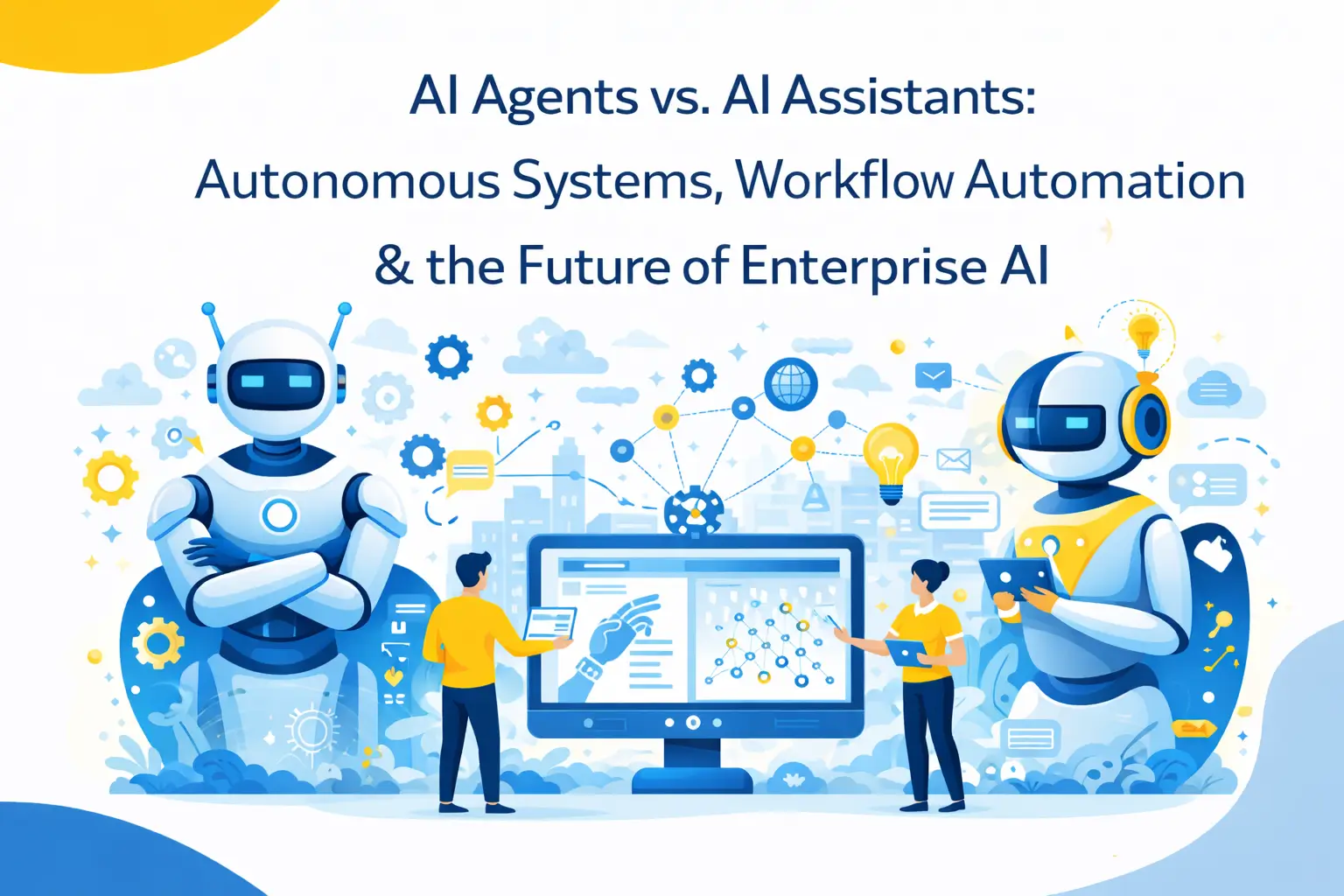
The Autonomy Spectrum: From Reactive Tools to Proactive Systems
The landscape of AI Agents vs AI Assistants requires careful consideration, especially as businesses seek to automate and optimize their operations.
In discussions around AI Agents vs AI Assistants, it’s important to recognize how each plays a role in shaping enterprise workflows.
The ongoing debate of AI Agents vs AI Assistants highlights the need for clarity in technological capabilities.
Understanding the AI Agents vs. AI Assistants distinction requires mapping the full autonomy spectrum, recognizing that these are not binary categories but represent progressive capabilities along a continuum of agency. At the foundational level, AI assistants are prompt-dependent, single-turn systems designed to augment human productivity through recommendations, content generation, and information retrieval. They operate through reactive architecture, responding only to explicit user inputs with limited memory across conversation sessions, executing one request per prompt such as drafting an email, summarizing a document, or answering a question. Every output requires human review and action, making them fundamentally human-in-the-loop systems. ChatGPT, Claude, Microsoft Copilot in its basic mode, Google Gemini, Siri, and Alexa all fall within this category. In a typical enterprise application, a customer service representative might use an AI assistant to draft email responses based on knowledge base articles, but the human must review, edit, and send each message, maintaining full control over the communication flow.
Exploring AI Agents vs AI Assistants unveils the potential benefits and challenges associated with each approach.
The architectural differences between AI Agents vs AI Assistants shape their effectiveness in various applications.
To grasp the full impact of AI Agents vs AI Assistants, one must delve into their operational frameworks.
Knowledge of AI Agents vs AI Assistants is vital for understanding how to effectively implement AI in business processes.
Moving along the spectrum, AI copilots represent an intermediate category of embedded assistants integrated into specific software workflows with contextual awareness of the application state. These systems maintain context within specific workflow sessions, engage in multi-turn conversations, propose actions but require human approval for execution, and can call APIs within bounded, pre-approved scopes. GitHub Copilot, Salesforce Einstein Copilot, Microsoft 365 Copilot, and ServiceNow Now Assist exemplify this category. A developer using GitHub Copilot experiences this intermediate state—the AI suggests code completions based on the current file context and project repository, understanding the codebase structure but not autonomously refactoring entire systems. The copilot augments the developer’s capabilities within a specific environment without assuming independent control of the development process.
At the far end of the spectrum reside AI agents, which are goal-oriented, multi-step systems capable of independent planning, tool orchestration, and end-to-end task completion. These systems autonomously plan by decomposing high-level goals into actionable sub-tasks without step-by-step human guidance, dynamically select and execute tools and external systems, maintain long-term memory and context across extended workflows lasting hours to days, adapt strategies based on intermediate results and environmental feedback, and operate under human-on-the-loop oversight where they escalate exceptions or critical decisions for human review. AutoGPT, CrewAI multi-agent systems, OpenAI Operator, Adept AI, and enterprise supply chain optimization agents demonstrate these capabilities. Consider the difference in a financial operations context: an AI agent might receive the goal to process all pending supplier invoices from the accounts payable inbox, verify them against purchase orders in the ERP system, flag discrepancies over $1,000, and schedule payments for approved items. The agent would then autonomously access email, query the ERP database, perform three-way matching, update records, execute payment workflows, and report completion status without intermediate human intervention, notifying staff only for exceptions that fall outside defined parameters. This represents a qualitative shift from assistance to autonomous execution, from human-paced to machine-paced workflow completion.
Read: What Is Retrieval Augmented Generation and Why 70% of Enterprises Are Using It
Architectural Foundations: How the Underlying Technology Differs
The technical architecture underlying AI assistants versus AI agents reveals why their capabilities diverge so dramatically. AI assistants operate through a straightforward linear process: user input flows into LLM processing, which generates a response that requires human action. This single-model inference architecture relies on one LLM call per interaction, operates within a static context window limited to prompt length typically ranging from 4,000 to 128,000 tokens, maintains no persistent state with conversational history managed externally if at all, and produces deterministic output based directly on training data and prompt engineering. The simplicity of this architecture enables rapid deployment and predictable behavior but inherently limits the system’s ability to handle complexity spanning multiple steps or extended timeframes.
AI agents by contrast employ a fundamentally different architectural pattern organized around continuous reasoning loops rather than single inference passes. The architecture begins with goal input feeding into a planning module that decomposes objectives into executable strategies, which then feeds into tool selection mechanisms that dynamically choose appropriate resources from available APIs and functions. An execution loop runs these operations while maintaining feedback pathways that allow the system to observe environmental responses, evaluate outcomes, and iterate until goals are achieved. This creates a cyclical rather than linear process where the agent continuously observes its environment, takes actions, evaluates results, and adapts its approach.
The component layers of agent architecture reveal the complexity involved in production deployment. The planning engine handles task decomposition and execution strategy formulation using techniques like ReAct prompting, Chain-of-Thought reasoning, and Tree of Thoughts exploration. Memory systems provide both short-term working memory for active contexts and long-term storage through vector databases like Pinecone, Weaviate, or Redis, often managed through frameworks such as LangChain Memory. The tool registry catalogs all APIs, databases, and functions the agent can invoke, accessed through function calling capabilities, Model Context Protocol standards, or API gateways. The execution runtime orchestrates the agent loops, handles errors, and manages state using platforms like LangGraph, CrewAI, AutoGen, or OpenAI Agents SDK. Finally, the evaluation layer provides self-correction mechanisms, output validation, and human escalation triggers through guardrails, evaluation frameworks, and confidence scoring systems.
Advanced enterprise deployments increasingly utilize multi-agent architectures where specialized agents collaborate like digital teams. A planner agent might decompose objectives and assign tasks to specialized colleagues, while a research agent gathers information from databases and web sources, an execution agent performs actions like updating records or sending communications, a verification agent validates outputs for accuracy and compliance, and an escalation agent interfaces with human oversight when confidence thresholds indicate potential problems. Frameworks like CrewAI formalize this collaboration through role-based abstractions, enabling crew configurations where agents hand off tasks, share context, and resolve dependencies autonomously. By the third quarter of 2025, CrewAI reportedly orchestrated over 1.1 billion agent actions across enterprise workflows, demonstrating the scale at which these multi-agent systems now operate.
The Enterprise Reality: Why Assistants Fall Short and Agents Deliver
The limitations of AI assistants in enterprise environments become apparent when examining the messy reality of integrating AI into complex organizational workflows. Enterprise AI requires deep contextual awareness that simple assistants struggle to provide—it must understand security permissions, user roles, and historical interactions, otherwise it creates more problems than it solves. If AI agents fail to get context right, they become useless or even dangerous. Imagine a financial analyst using an AI copilot that retrieves confidential data not meant for their clearance level, creating immediate security and compliance risks. AI must also segment knowledge correctly: a customer support copilot must prioritize real-time query resolution, an IT assistant must pull from technical documentation rather than marketing materials, and a sales-focused agent needs access to CRM data without surfacing internal financials. Without intelligent segmentation, AI models return generic, irrelevant, or even dangerous results.
Microsoft Copilot’s enterprise experience illustrates these challenges vividly. Given Microsoft’s reputation as an enterprise software giant, businesses eagerly rushed to deploy Microsoft Copilot with promises of an intelligent assistant embedded within Microsoft 365 capable of generating documents, summarizing emails, and automating routine tasks. The reality has proven underwhelming for many enterprises due to lack of deep workflow integration where AI suggestions feel disconnected from actual enterprise processes, context limitations where Copilot struggles with role-based access and personalization, and high cost with questionable value as companies pay millions for AI licenses yet employees default back to manual workarounds. These underwhelming experiences lead enterprises to conclude that AI isn’t for them, when in fact they have encountered the limitations of assistant-level AI rather than experiencing the full potential of agentic systems.
The data infrastructure challenges compound these issues. According to the 2025 Global Enterprise AI Survey, 44% of organizations reported lacking systems to efficiently move large data sets, while 41% struggled with inaccurate and inconsistent data. AI assistants stumble because enterprise rules aren’t always structured, accessible, or consistent across systems, making it difficult for them to reason about whether actions are permitted before acting. When an AI assistant approves a hardware request that finance later rejects because it didn’t understand the approval chains, SLAs, change windows, and catalog rules living in ITSM workflows and governance tools, trust erodes and adoption suffers.
AI agents address these limitations through their capacity for end-to-end workflow ownership. Rather than providing suggestions that humans must then execute across multiple systems, agents can resolve issues, update records across systems, initiate follow-ups, and surface exceptions for review. They don’t merely detect invoice discrepancies; they reconcile them within defined policy constraints. They don’t simply rank leads; they can launch supervised outreach sequences aligned to sales strategy. This shift from assistance to accountability defines true enterprise AI transformation, moving from AI-augmented workflows toward AI-orchestrated execution where systems set goals such as autonomously managed operations, real-time adaptation, and continuously optimized processes with minimal human oversight.
Comparative Analysis: Dimensions of Difference
When evaluating AI Agents vs. AI Assistants across operational dimensions, the distinctions become stark and strategically significant. The interaction model separates reactive systems that respond to prompts from proactive systems that pursue goals autonomously. Task complexity capabilities divide single-step bounded operations from multi-step open-ended processes. Decision authority differentiates between systems limited to recommendations versus those capable of action execution with appropriate guardrails. Memory and state management contrasts session-limited ephemeral contexts against persistent long-term cross-session awareness. Tool integration approaches separate static pre-configured connections from dynamic runtime-selected resources. Human involvement requirements distinguish human-in-the-loop mandatory participation from human-on-the-loop oversight models. Error handling capabilities divide systems where humans must detect and correct all mistakes from those with self-monitoring, automatic retry, and escalation protocols. Scalability characteristics contrast linear scaling with human operators against exponential parallel execution capacity. Implementation complexity ranges from low-effort API integration to high-investment orchestration, governance, and evaluation requirements. Finally, risk profiles separate low-risk environments where humans validate all outputs from moderate-to-high risk scenarios where autonomous actions demand robust safeguards.
These dimensional differences explain why recent advances in computing power and AI-optimized chips can reduce human error and cut employees’ low-value work time by 25% to 40% through proper agent deployment. These agents work continuously without interruption and can handle data traffic spikes without proportional headcount increases. The AI-powered workflows they create can accelerate business processes by 30% to 50% in areas ranging from finance and procurement to customer operations, delivering transformation rather than mere incremental improvement.
Implementation Trajectory: From Pilot to Production
Organizations beginning their journey into autonomous AI must navigate a complex implementation landscape where technical integration, organizational change, and governance frameworks converge. The immediate phase spanning zero to six months should focus on auditing current AI portfolios to categorize existing tools as assistants, copilots, or agents, identifying agent opportunities by mapping high-volume rules-based workflows with clear success metrics, establishing governance frameworks that define approval workflows risk thresholds and oversight mechanisms, and selecting pilot projects with bounded scope such as expense processing or IT ticket routing where the consequences of failure are manageable but the learning potential is significant.
The medium-term initiatives from six to eighteen months require building agent infrastructure including observability evaluation frameworks and tool integration platforms, developing agent literacy across the organization through training on agent supervision exception handling and human-AI collaboration, scaling successful pilots to adjacent workflows once proof of concept validates the approach, and conducting thorough vendor evaluations assessing enterprise agent platforms against security and scalability requirements. This phase often reveals that making agentic AI work in practice involves unexpected challenges where the biggest hurdle isn’t prompt engineering or model fine-tuning but rather the unglamorous work of data engineering, stakeholder alignment, governance, and workflow integration. Research indicates that 80% of implementation effort can be consumed by converting data into standard structured formats, establishing continuous validation frameworks, robust API management, and working with vendors to ensure they’re up-to-date on the latest model versions.
The long-term transformation extending beyond eighteen months involves organizational redesign restructuring teams around agent supervision and strategic exception handling rather than routine execution, outcome-based measurement shifting from activity metrics like tickets processed to business outcomes like customer satisfaction and cost per transaction, multi-agent ecosystem deployment across departmental boundaries, and continuous governance evolution as agent capabilities advance. This trajectory requires treating AI as a product with assigned design authority over the agents’ processes, implementing control mechanisms, and creating human-in-the-loop fallbacks while accomplishing structural and cultural change including platform re-architecture moving from static APIs to event-driven or agent-compatible infrastructure, operating model shifts embedding agents into core value chain operations rather than just peripheral functions like helpdesk support, and AI talent strategies hiring or training teams that can design agent ecosystems rather than just models.
Risk Management: Navigating the Challenges of Autonomy
The autonomy that makes AI agents powerful also introduces risks that demand sophisticated management approaches. Compounding errors represent a unique agent risk where unlike assistants with immediately visible mistakes, agents can propagate errors across multiple workflow steps before detection, with an incorrect data retrieval in step one cascading through subsequent actions to produce systematically flawed outcomes. Tool misuse presents another concern as agents with broad API access may invoke tools inappropriately—deleting records instead of updating them or accessing unauthorized data scopes. Goal misalignment emerges when without careful prompt engineering and constraints, agents optimize for proxy metrics rather than true business objectives, such as minimizing response time at the expense of solution quality or customer satisfaction.
Ultimately, the distinction between AI Agents vs AI Assistants will shape future AI strategies and implementations.
As organizations consider AI Agents vs AI Assistants, they must prepare for the evolving landscape of AI technology.
Security vulnerabilities specific to agent architectures include prompt injection attacks where malicious inputs cause unauthorized agent actions, insecure output handling where agent-generated content executes unintended commands, and excessive agency where systems are granted more permissions than necessary for their legitimate functions. The OWASP Top 10 for LLM Applications identifies these as critical risks requiring mitigation through the principle of least privilege where agents receive minimum necessary tool permissions, human-in-the-loop requirements for irreversible actions such as payments data deletion or customer communications, comprehensive monitoring with real-time alerting for anomalous agent behavior patterns, red teaming adversarial testing of agent guardrails before production deployment, and regulatory compliance maintenance including audit trails and risk documentation for high-risk AI systems under frameworks like the EU AI Act.
Governance frameworks must address the personality dimensions of AI agents as well. Research indicates that designing AI agents to have personalities that complement the personalities of other agents and human colleagues leads to better performance, productivity, and teamwork outcomes. People with open personalities perform better when working with conscientious and agreeable AI agents, whereas conscientious people perform worse with agreeable agents. An overconfident human benefits from an AI agent that pushes back, but that same agent personality type might not have a positive effect on a less-confident individual. This human-centered approach to decision-making requires embracing governance not as a constraint on innovation but as an enabler that allows organizations to use the full potential of AI agents while trusting them to do the right work.
The Future Landscape: Transformation and Trajectory
Looking ahead to 2025 through 2028, three converging trends will define the agentic AI landscape. Enhanced reasoning capabilities building on advanced models will enable sophisticated chain-of-thought reasoning, allowing complex problem decomposition and explanation of decision pathways. Multi-agent orchestration will move enterprises from single agents to swarms of specialized agents that negotiate, delegate, and collaborate through patterns enabled by frameworks like Microsoft’s AutoGen and CrewAI’s multi-agent architectures. Tool integration standardization will emerge through protocols like the Model Context Protocol by Anthropic, creating open standards for connecting agents to data sources and tools that reduce integration fragmentation.
By 2028, Gartner predicts that 33% of enterprise software will include autonomous AI agents, though they caution that over 40% of agentic AI projects will be canceled due to unclear business value. Success will depend on outcome-based metrics measuring resolution rates cost reduction and cycle time improvement rather than usage statistics, platform consolidation shifting from fragmented point solutions to integrated agent platforms with unified governance, and human-AI collaboration models redefining job roles around agent supervision exception handling and strategic decision-making. The future of enterprise work will not be fully automated but intelligently augmented, with organizations that recognize this early defining the next phase of enterprise performance.
Conclusion: The Strategic Imperative
The distinction between AI Agents vs. AI Assistants represents a fundamental choice in enterprise AI strategy that extends far beyond technology selection to encompass organizational design, risk tolerance, and competitive positioning. Assistants amplify human capabilities within defined boundaries while agents transcend those boundaries to operate as autonomous digital workers. This is not a binary replacement scenario but a spectrum of augmentation and automation where the future lies in intelligent orchestration—deploying assistants where human judgment adds value, agents where autonomy drives efficiency, and seamless handoffs between the two.
The $52 billion agent market projection by 2030 predicts not merely technology adoption but the restructuring of work itself. Enterprises that begin building agent capabilities, governance frameworks, and human-agent collaboration models today will define the competitive landscape of the next decade. Those that move deliberately will not simply reduce operational overhead but improve execution velocity, consistency, and adaptability. The question is no longer whether AI agents will reshape enterprise operations, but whether your organization will redesign itself intentionally—building autonomous AI systems, embedding strong AI governance, and enabling collaborative AI workforces—or adapt later under competitive pressure. The future of enterprise work will be intelligently augmented, and organizations that recognize this early will lead in defining how business operates in the digital age.