
Software testing trends 2026 place accountability and telemetry at the heart of quality. This article explains the technical and organizational shifts shaping testing in 2026, clarifies what success looks like, and offers a practical roadmap for engineering organizations that must increase velocity without sacrificing trust.
Executive summary
- Agentic and generative-AI testing moves from assistant tooling to autonomous agents that generate, execute, and triage tests.
- Verification debt from AI-generated code requires explicit testing and governance.
- Continuous quality unifies shift-left and shift-right practices through observability, contract testing, and synthetic monitoring.
- Test automation becomes more data-centric and model-driven while low-code platforms broaden contributor bases.
- Security, privacy, accessibility, and customer experience become measurable testing outcomes.
This article unpacks each trend, explains business and engineering implications, and prescribes concrete next steps to adopt these patterns responsibly.
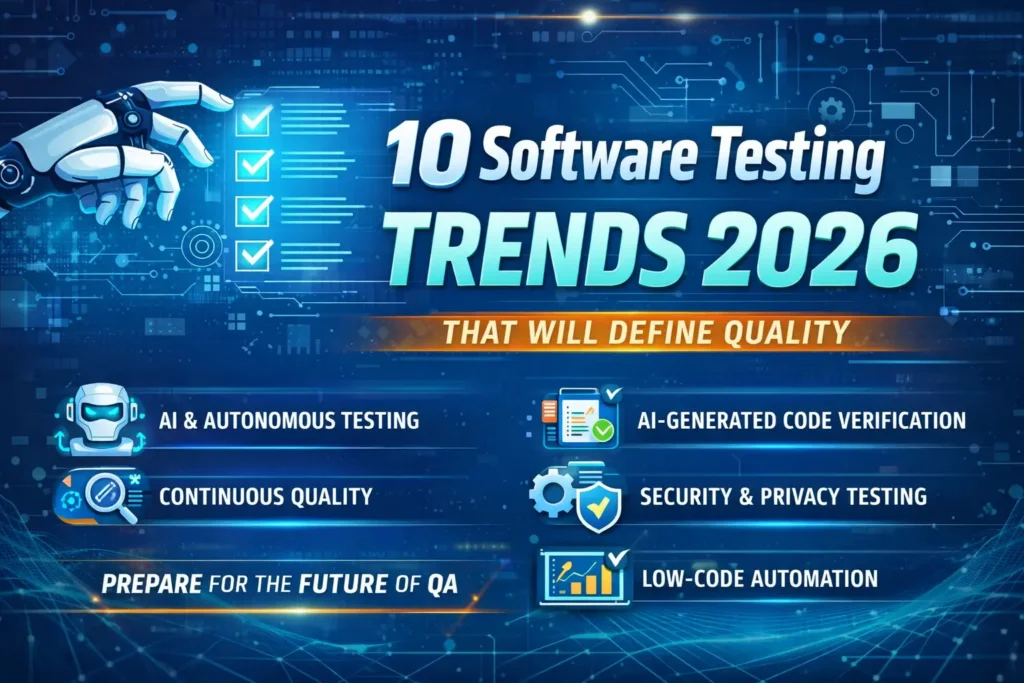
Table of Contents
1. Agentic and generative-AI testing becomes operational
What changed. In 2026 the industry adopted agentic AI systems: multi-component agents that plan, act, and coordinate to complete testing tasks. Rather than a human invoking a single prompt, testing agents can discover user flows, create test data, execute cross-environment suites, triage failures, and file tickets. These agents reduce repetitive engineering work and increase test throughput.
Implications. Agents introduce new risk categories. False positives and negatives from agent decisions can erode trust unless teams adopt governance: audit trails of agent prompts, confidence thresholds for actions, and explicit human checkpoints for high-risk releases. For regulated domains, agentic actions must be traceable and reversible.
Practical action. Pilot agents on non-production areas such as documentation validation or smoke tests. Instrument agent outputs with metadata, capture prompts and rationale, and build a review loop so humans can validate or override agent actions.
Read: Tech Trends 2026: Technologies Shaping the Year Ahead
2. Verification debt from AI-generated code is a first-class testing concern
What changed. Heavy adoption of code-generation tools increased developer productivity and created verification debt: unverified AI outputs entering source control. Unlike hand-written code, AI-generated code can appear plausible while containing subtle logical errors or insecure patterns.
Implications. Tests must explicitly target AI-generated artifacts. Unit tests should exercise probable edge cases, contract tests must assert precise interfaces, static and semantic analyses should look for patterns commonly produced by code-generation models, and runtime fuzzing should probe boundary conditions.
Practical action. Adopt policies that require explicit acceptance criteria for any AI-produced feature. Gate production merge commits on additional verification steps and use feature flags with staged rollouts to reduce risk exposure.
3. Continuous quality: bridging shift-left and shift-right with observability
What changed. The traditional distinction between pre-release and production testing gave way to continuous quality, integrating CI tests with production telemetry. Observability systems now feed into QA workflows so test failures are correlated with traces, metrics, and session replays to assess real user impact.
Implications. Test outcomes are evaluated alongside business KPIs. Failures that do not materially affect user experience can be deprioritized; regressions that affect latency or error rates are escalated faster because telemetry points to user impact.
Practical action. Store test traces, metrics, and logs with every CI run. Correlate failures with production telemetry and set error budgets or KPIs that testing must protect.
4. Contract-first engineering and contract testing are the backbone of CI/CD
What changed. Architectures built around microservices and third-party APIs elevated contract testing to core pipeline functionality. Consumer-driven contract tests validate integration expectations before services are deployed, dramatically reducing brittle end-to-end suites.
Implications. Teams must publish versioned contract artifacts and run contract checks as CI gates. Independent deployment cadence becomes feasible because contracts reduce integration risk.
Practical action. Create a contract registry, require contract verification in pull requests, and automate contract compatibility checks during deployments.
5. Automation evolves: low-code, model-based, and data-centric approaches
What changed. Test automation no longer means only scripted Selenium flows. Low-code/no-code platforms make reliable UI and integration test creation accessible to product teams. Model-based testing generates extensive coverage from system models. Data-centric testing emphasizes realistic, privacy-preserving synthetic datasets.
Implications. Organizations can scale test creation but must invest in governance to avoid test sprawl and brittle suites. Quality now depends on managing test data and model definitions, not only on scripts.
Practical action. Use low-code platforms for repeatable flows while retaining code hooks for complex cases. Apply model-based techniques to exercise stateful systems and invest in synthetic test data pipelines that emulate production distributions without exposing sensitive data.
6. Security, privacy, accessibility, and CX are measured test outcomes
What changed. QA budgets and ownership shifted from pass/fail counts to measurable customer experience (CX) and compliance outcomes. Accessibility, privacy, and performance tests are no longer optional checkboxes but part of the quality SLAs that teams must meet.
Implications. Test planning requires clear SLAs — performance budgets, accessibility standards, and privacy constraints. Security testing becomes continuous, including dependency scanning, static analysis, and runtime protection.
Practical action. Convert CX goals into automated checks that integrate in CI and map results to product KPIs. Require remediation SLAs for security and accessibility findings based on severity.
7. Observability and ML-driven triage reduce time-to-fix
What changed. Observability tools matured to capture contextual artifacts for failed tests: full traces, relevant logs, screenshots, and session replays. ML models rank failures and suggest likely root causes, enabling faster and more accurate triage.
Implications. Test artifacts must be structured and high quality. ML-driven prioritization reduces noise but relies on labeled historical incidents to be accurate.
Practical action. Ensure tests emit structured telemetry. Maintain a labeled incident dataset to train prioritization models. Use replay and tracing to accelerate root-cause analysis.
8. Regulatory and audit-ready pipelines are required in regulated industries
What changed. With AI in the development loop and agentic testing in use, compliance teams demand reproducible validation records. Auditable pipelines that record test rationale, agent interactions, and environment state are now mandatory in finance, healthcare, and telecom.
Implications. Teams must preserve immutable artifacts for each release: test inputs, agent prompts and outputs, evaluation results, and environment descriptors.
Practical action. Implement immutable storage for test artifacts, enforce environment reproducibility, and expose audit APIs that compliance teams can query.
9. Skills and organizational shifts: testers become strategists, curators, and auditors
What changed. The role of testers now emphasizes domain expertise, observability literacy, data skills, and AI governance experience. Routine script writing is increasingly automated; the strategic value lies in defining acceptance criteria, validating agent outputs, and shaping test architecture.
Implications. Hiring and training must pivot. Organizations should upskill QA teams in telemetry, data engineering, and governance, and embed quality specialists within product squads.
Practical action. Provide upskilling on observability tools, contract testing, and data management. Redesign team structures so QA specialists partner closely with product and SRE teams.
10. Implementation roadmap for the next 12–18 months
- Catalog AI touchpoints. Identify where code, tests, or documentation are AI-generated and create verification policies.
- Adopt contract-first practices. Make contract checks CI gates and maintain a central registry.
- Pilot agentic testing. Start with low-risk flows and ensure audit trails are captured.
- Integrate telemetry with CI. Store test traces and metrics alongside results and correlate with production observability.
- Make CX and security measurable. Convert experience targets into automated checks tied to SLAs and product KPIs.
- Invest in synthetic test data. Build pipelines that generate privacy-preserving, realistic datasets for comprehensive testing.
- Retrain QA staff. Focus on observability, data skills, and governance capabilities.
Measuring success
Adopt a small set of outcome-based metrics to determine whether testing changes deliver value:
- Mean time to detect and resolve critical regressions.
- Percentage of production incidents caught by CI or synthetic tests.
- Error budget consumption relative to SLA.
- Time to validate and release AI-assisted features.
- Flakiness rate for automated suites after introducing agents.
Regularly review these metrics against business KPIs and adjust investments accordingly.
Closing perspective
The software testing trends 2026 emphasize accountability, integration with production telemetry, and governance around AI. Automation and agentic systems boost efficiency, but they also shift the burden of trust to reproducible validation, clearer contracts, and observability. Organizations that balance productivity with rigorous verification and measurable outcomes will reduce risk while accelerating delivery.
Read: ISTQB Glossary Explained: 50 Essential Software Testing Terms You Must Know