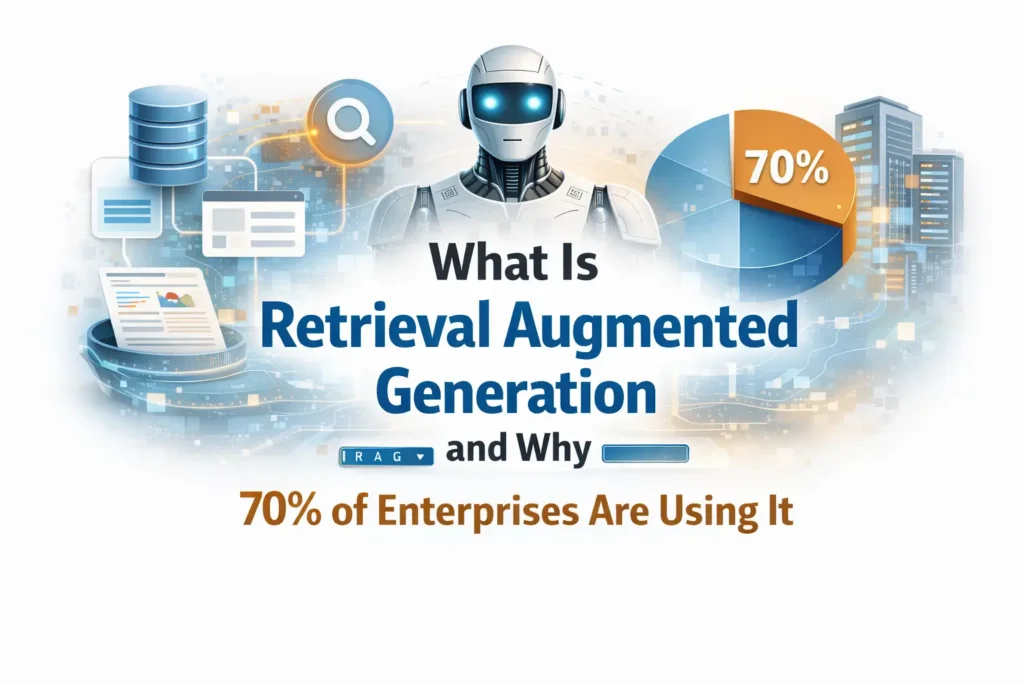
Retrieval Augmented Generation has become the dominant architecture for enterprise artificial intelligence deployment, with industry surveys indicating adoption rates exceeding seventy percent among organizations actively implementing generative AI solutions. This remarkable uptake reflects a fundamental shift in how businesses approach large language model applications—moving away from reliance on static pre-trained knowledge toward dynamic systems that combine parametric memory with real-time information retrieval. The transition represents not merely a technical preference but a strategic response to the limitations that prevent standalone language models from delivering reliable business value.
Organizations experimenting with generative AI quickly encounter a critical constraint. Foundation models, regardless of scale, encode knowledge only from their training data, creating knowledge cutoff dates that render them obsolete for current information. They hallucinate—generating plausible but false information with confident delivery. They lack visibility into proprietary organizational knowledge, the very data that differentiates one enterprise from competitors. They struggle to cite sources, making verification difficult and compliance impossible. These limitations make them unsuitable for high-stakes business applications despite their impressive conversational capabilities.
Retrieval Augmented Generation addresses these deficiencies through architectural separation of concerns. Rather than expecting language models to store, retrieve, and synthesize information within a single parametric structure, RAG systems externalize knowledge storage to specialized retrieval mechanisms while reserving language models for their core competency—reasoning over provided context to generate coherent, relevant responses. This separation enables independent optimization of knowledge currency, completeness, and verifiability while maintaining the linguistic sophistication that makes large models valuable.
The enterprise enthusiasm for this approach stems from tangible business outcomes. Organizations report significant reductions in hallucination rates compared to baseline model performance. They achieve visibility into model information sources, enabling verification and audit trails required for regulatory compliance. They can update system knowledge without retraining expensive models, reducing operational costs and improving agility. Most importantly, they can ground AI responses in proprietary organizational knowledge—the specific documents, data, and institutional memory that constitute genuine competitive advantage.
Read: How to Deploy Generative AI in Enterprise Without Violating EU AI Act Compliance
The Fundamental Architecture of RAG Systems
Understanding Retrieval Augmented Generation requires examining how its components interact to transform user queries into informed, verifiable responses. The architecture operates through three sequential stages, each presenting distinct engineering challenges and optimization opportunities.
The indexing stage prepares organizational knowledge for efficient retrieval. Source documents—ranging from structured databases to unstructured text, images, and multimedia—undergo processing that extracts semantic meaning and creates searchable representations. Modern systems typically employ embedding models that transform text into high-dimensional vectors capturing semantic relationships. Unlike keyword indexing that matches exact terms, semantic embeddings enable retrieval based on conceptual similarity, allowing systems to find relevant information even when terminology differs between queries and source documents.
Chunking strategies critically influence retrieval quality. Documents must be divided into segments small enough to fit within model context windows yet large enough to preserve coherent meaning. Overly small chunks lose contextual relationships; overly large chunks dilute relevance signals and waste precious context capacity. Advanced implementations use overlapping windows, hierarchical structures, or semantic boundary detection to optimize information preservation. Multi-modal sources require specialized processing—image captioning, table extraction, audio transcription—that unifies diverse formats into consistent vector representations.
The retrieval stage matches user queries against indexed knowledge. When a query arrives, the system embeds it using the same model applied during indexing, then searches the vector space for nearest neighbors—chunks semantically similar to the query intent. This similarity search must execute rapidly across potentially billions of documents while maintaining accuracy. Approximate nearest neighbor algorithms trade marginal recall improvements for dramatic speed increases, enabling millisecond response times across enterprise-scale knowledge bases.
Retrieval sophistication extends beyond simple similarity. Re-ranking models evaluate initial candidates with deeper semantic understanding, filtering out superficially similar but substantively irrelevant results. Hybrid approaches combine vector similarity with traditional keyword matching, capturing both conceptual alignment and specific term importance. Metadata filtering restricts searches to document subsets based on attributes like date, author, department, or security classification, ensuring responses respect organizational boundaries and information governance policies.
The generation stage synthesizes retrieved information into coherent responses. Language models receive carefully constructed prompts containing the original query alongside retrieved context chunks, instructed to base responses solely on provided information while citing sources. Prompt engineering proves crucial—models must understand their role, the importance of faithfulness to sources, and appropriate handling of cases where retrieved information proves insufficient or contradictory.
Context window management presents ongoing challenges as model capabilities evolve. While newer models offer expanded context lengths, retrieval quality often degrades when excessive information overwhelms the synthesis capability. Effective systems curate retrieved chunks, prioritize by relevance, and structure context to highlight most pertinent information. Source citation requirements add complexity—models must track information origins through generation and format citations consistently, enabling users to verify claims against original documents.
Why Enterprises Are Adopting RAG at Scale
The seventy percent adoption figure reflects compelling advantages that Retrieval Augmented Generation offers over alternative approaches to enterprise knowledge applications. These advantages span technical, operational, and strategic dimensions that collectively address the barriers preventing production deployment of generative AI.
Knowledge currency represents an immediate practical benefit. Business environments change continuously—product specifications update, policies evolve, market conditions shift, competitive landscapes transform. Static models capture knowledge only from training data, becoming outdated the moment training completes. RAG systems maintain currency by indexing current documents, with updates reflecting in system behavior as soon as indexing processes complete. This eliminates the need for expensive retraining or fine-tuning to incorporate new information, reducing time-to-knowledge from weeks or months to minutes or hours.
Hallucination reduction addresses the reliability concerns that plague standalone model deployment. By grounding generation in retrieved documents rather than parametric memory, RAG systems constrain outputs to information present in authoritative sources. While not eliminating hallucination entirely—models may misinterpret retrieved content or inappropriately synthesize contradictory information—the approach dramatically reduces ungrounded fabrication. Organizations report accuracy improvements that transform AI systems from interesting experiments into trusted tools for operational decision-making.
Source attribution enables verification and compliance. Enterprise applications require accountability—users must verify information accuracy, auditors must trace decision rationales, regulators must assess compliance with information governance requirements. RAG systems provide explicit provenance, citing the specific documents supporting each claim. This transparency satisfies audit requirements, supports human oversight, and enables confidence calibration—users can assess source reliability and decide whether to accept AI-generated conclusions.
Proprietary knowledge integration unlocks competitive differentiation. Generic foundation models trained on public internet data lack visibility into organizational intellectual property—internal research, customer interaction histories, proprietary methodologies, strategic planning documents. RAG systems make this knowledge accessible through AI interfaces without exposing it to model training processes that would compromise confidentiality. Employees gain AI assistance informed by organizational specifics, competitors remain unable to extract proprietary insights through model interactions, and intellectual property stays within organizational boundaries.
Cost efficiency emerges through architectural separation. Foundation model capabilities improve with scale, but scaling comes at substantial computational expense. RAG architectures enable effective performance using smaller, cheaper models by offloading knowledge storage to specialized retrieval systems. The approach reduces token consumption—instead of including extensive background information in prompts, systems retrieve only relevant excerpts. These efficiencies compound at enterprise scale, where thousands of employees conduct millions of interactions monthly.
Operational control satisfies enterprise governance requirements. Organizations can audit exactly what information systems access, implement granular permissions restricting retrieval based on user roles, and remove sensitive information from indexes when required. Unlike fine-tuned models where knowledge becomes inseparable from parameters, RAG systems maintain clear boundaries between model capabilities and organizational knowledge, enabling governance approaches impossible with alternative architectures.
Implementation Patterns and Technical Considerations
Successful Retrieval Augmented Generation deployment requires attention to engineering details that distinguish production systems from proof-of-concept demonstrations. Organizations achieving widespread adoption have refined implementation patterns addressing scalability, reliability, and user experience.
Vector database selection significantly influences system characteristics. Purpose-built vector databases like Pinecone, Weaviate, and Milvus optimize similarity search performance across billions of embeddings, offering managed services that reduce operational burden. Traditional databases with vector extensions—PostgreSQL with pgvector, MongoDB Atlas—provide familiarity and integration advantages for organizations with existing data infrastructure. Cloud-native options from major providers—Azure AI Search, Amazon Kendra, Google Vertex AI—offer tight integration with broader platform ecosystems. Selection criteria include scale requirements, latency constraints, hybrid search needs, operational expertise, and vendor relationship considerations.
Embedding model choice affects retrieval quality profoundly. While general-purpose models like OpenAI’s text-embedding-ada-002 or open alternatives from Sentence-Transformers provide strong baselines, domain-specific fine-tuning often improves retrieval accuracy for specialized content. Multi-lingual requirements demand models trained on diverse language corpora. Recent multi-modal embeddings unify text, image, and structured data representation, enabling retrieval across content types. Organizations must evaluate whether standard models suffice or domain adaptation justifies custom training investments.
Chunking and preprocessing pipelines require domain-aware design. Legal documents demand different segmentation strategies than technical manuals, research papers, or customer support transcripts. Table structures, code blocks, and hierarchical headings need preservation and appropriate metadata attachment. Preprocessing must handle document format diversity—PDFs, Word documents, HTML, scanned images—extracting meaningful text while preserving structural relationships. Investment in robust document processing distinguishes systems that handle real-world content diversity from those failing when encountering format complexity.
Query understanding and preprocessing improve retrieval effectiveness. User queries often differ substantially from document language—questions versus statements, conversational versus formal, implicit versus explicit information needs. Query expansion techniques add relevant terms or rephrase for better retrieval. Query classification routes questions to appropriate knowledge bases or specialized handlers. Conversational context maintenance enables follow-up questions that reference previous turns without full restatement. These preprocessing layers transform raw user inputs into optimized retrieval queries.
Re-ranking and result fusion optimize context composition. Initial retrieval casts wide nets capturing potentially relevant content; re-ranking applies more sophisticated relevance scoring to prioritize truly useful information. Cross-encoders that process query-document pairs jointly often outperform bi-encoders used for initial retrieval, albeit at higher computational cost. Results from multiple retrievers—vector similarity, keyword matching, structured queries—require fusion strategies that combine strengths while managing redundancy. These layers determine which information reaches the generation stage and strongly influence response quality.
Generation model selection balances capability, cost, and latency. While GPT-4 and comparable large models offer superior reasoning and instruction following, smaller models often suffice for well-structured RAG contexts and offer dramatic cost reductions. Fine-tuning on citation formats and domain-specific reasoning patterns improves output quality without increasing model size. Latency requirements for interactive applications may constrain model choice or necessitate streaming responses that display initial results while generation continues. Organizations typically implement tiered approaches—larger models for complex analytical tasks, smaller models for straightforward information retrieval.
Advanced RAG Techniques and Emerging Patterns
As Retrieval Augmented Generation matures, sophisticated techniques address limitations of basic implementations and expand application possibilities. Organizations leading adoption are moving beyond simple retrieve-then-generate patterns toward architectures that more closely resemble autonomous reasoning systems.
Self-querying retrieval enables handling of structured and unstructured data in unified systems. Language models generate structured queries—SQL, GraphQL, API calls—to retrieve precise information from databases alongside semantic search over documents. This hybrid approach answers questions requiring both specific data points and contextual explanation—”What were Q3 sales in the European region and how do they compare to historical performance?” The model decomposes such queries, executes appropriate retrievals, and synthesizes comprehensive responses.
Hypothetical document embeddings improve retrieval for complex queries. Rather than embedding the query directly, systems prompt models to generate hypothetical ideal answers, then embed these synthetic documents for similarity search. This technique bridges vocabulary and conceptual gaps between question phrasing and document content, particularly effective for complex analytical queries where relevant documents may not explicitly contain query terms.
Iterative and multi-hop retrieval supports complex reasoning requiring multiple information sources. Initial retrieval informs follow-up searches as the system recognizes information gaps or encounters references requiring resolution. Research-oriented implementations maintain explicit reasoning chains, tracking what information has been gathered, what remains needed, and how pieces connect. These patterns approach agent-like behavior, with retrieval and reasoning interleaved rather than sequential.
Context compression and summarization address token limitations. For knowledge bases exceeding practical context windows, systems must intelligently condense retrieved information while preserving essential content. Specialized summarization models compress document chunks, removing redundancy and highlighting key information. Hierarchical approaches summarize multiple chunks into higher-level representations, enabling reasoning across document collections too large for direct inclusion.
Fact verification and contradiction detection improve reliability. Systems can cross-reference claims against multiple retrieved sources, flagging inconsistencies for user attention or automatically resolving conflicts through confidence weighting. Post-generation verification checks that model outputs accurately reflect source documents, detecting instances of misinterpretation or inappropriate extrapolation. These verification layers add computational overhead but dramatically improve trustworthiness for high-stakes applications.
Personalization adapts retrieval to individual users and contexts. Retrieval ranking can incorporate user role, historical interactions, and current task context to prioritize most relevant information. Learning from user feedback—explicit ratings, implicit signals like dwell time and follow-up queries—improves retrieval quality over time. These adaptations make systems feel responsive to individual needs while maintaining consistent underlying knowledge bases.
Integration with Enterprise Systems and Workflows
Technical implementation succeeds only when Retrieval Augmented Generation integrates seamlessly into organizational workflows and systems. Adoption at scale requires attention to user experience, change management, and ecosystem connectivity.
User interface patterns range from chat-based interactions to embedded assistance within existing applications. Standalone chat interfaces provide universal access but require context switching from primary workflows. Embedded implementations—suggestions within document editors, assistance in customer relationship management systems, analysis capabilities in business intelligence tools—deliver value at the point of need. Effective implementations support multiple interaction modes, allowing users to choose appropriate interfaces for different tasks.
API-first architectures enable broad integration. Well-designed RAG services expose retrieval and generation capabilities through APIs that development teams can incorporate into diverse applications. This architectural pattern prevents siloed implementations and allows centralized governance of knowledge bases while enabling decentralized innovation in application development. Standardized interfaces facilitate swapping underlying components—vector databases, embedding models, generation models—as technologies evolve.
Workflow automation extends RAG from interactive assistance to autonomous processing. Systems can monitor information sources, trigger actions based on content changes, generate reports or notifications, and execute defined business processes. These autonomous applications require robust error handling, human oversight mechanisms, and clear boundaries on decision authority, but offer dramatic efficiency gains for information-intensive workflows.
Human feedback integration creates improvement flywheels. Explicit feedback mechanisms—thumbs up/down, correction suggestions, expert validation—provide signals for system refinement. Implicit signals—query reformulation patterns, result selection behavior, time-to-task-completion metrics—reveal system limitations without burdening users. Structured processes incorporate this feedback into index updates, prompt refinement, and model fine-tuning, creating systems that improve through operational use.
Governance and monitoring maintain quality as scale increases. Content moderation ensures indexed information meets organizational standards. Usage analytics reveal adoption patterns, common failure modes, and opportunities for enhancement. Access controls enforce information security boundaries. Regular audits verify that retrieval and generation behavior aligns with organizational values and regulatory requirements.
Challenges and Limitations
Despite its advantages, Retrieval Augmented Generation faces significant challenges that organizations must acknowledge and address. Unrealistic expectations lead to disappointment; proper understanding enables appropriate application and continued refinement.
Retrieval failures remain common and often invisible. Systems may fail to find relevant information due to vocabulary mismatches, embedding quality limitations, or indexing gaps. Unlike obvious generation errors, retrieval failures produce plausible but incomplete responses that users may not recognize as deficient. Robust implementations include confidence estimation, explicit acknowledgment of information gaps, and easy escalation to human experts when retrieval uncertainty is high.
Context window limitations continue constraining complex analysis. Even expanded windows cannot accommodate comprehensive coverage of large document collections, forcing trade-offs between breadth and depth. Information compression inevitably loses nuance. Multi-document synthesis struggles to maintain coherence across many sources. These limitations mean RAG excels at specific information retrieval but faces challenges with holistic analysis requiring broad knowledge integration.
Maintenance requirements are substantial and ongoing. Knowledge bases require continuous updating as information changes. Indexing pipelines need monitoring and refinement. Embedding models may require updates as language evolves. User feedback must be processed and incorporated. Organizations underestimating these operational commitments see system quality degrade over time, undermining initial adoption enthusiasm.
Evaluation complexity exceeds traditional metrics. Accuracy assessment requires domain expertise to judge response quality. Retrieval and generation components interact, complicating attribution of failures. Real-world performance depends on query distributions that differ from test sets. Comprehensive evaluation demands ongoing investment in assessment infrastructure and methodology.
The Future of Enterprise Knowledge Systems
Retrieval Augmented Generation represents an architectural foundation rather than a final destination. Current implementations are early stages of evolution toward more sophisticated enterprise knowledge systems that will transform how organizations leverage their information assets.
Integration with agent architectures enables autonomous task completion. RAG systems provide the knowledge foundation; agent systems add planning, tool use, and execution capabilities. Together, they enable applications that independently research topics, synthesize findings, generate deliverables, and execute workflows—transforming knowledge access into knowledge work automation.
Multimodal expansion unifies information types. Text-only RAG gives way to systems that retrieve and reason over images, video, audio, and structured data in integrated ways. Technical documentation includes diagrams and schematics; customer interactions encompass call recordings and screen shares; research involves datasets and visualizations. Unified multimodal retrieval enables comprehensive assistance across all organizational information types.
Real-time and streaming information incorporation addresses the velocity of modern business. Current systems index batch-processed documents; future implementations will integrate live data streams, real-time communications, and dynamic system states. This evolution enables applications that understand not just accumulated organizational knowledge but current operational context—supporting decisions with awareness of ongoing situations.
Personal knowledge assistants will augment individual cognition. Beyond organizational knowledge bases, systems will maintain personal indexes of individual documents, communications, notes, and interactions. These personal RAG systems will provide memory extension—recalling relevant past experiences, surfacing connections across projects, and maintaining continuity across extended professional relationships.
The seventy percent adoption figure will grow as these capabilities mature. Organizations currently experimenting with Retrieval Augmented Generation are building foundations—data infrastructure, engineering expertise, governance frameworks—that will enable increasingly sophisticated applications. The technology transition from novelty to utility, from experimental to essential, is well underway. Organizations that master RAG implementation today are positioning themselves to lead as these systems become central to knowledge work across every industry and function.