DevOps has become a foundational concept in modern software engineering, yet it is still widely misunderstood. Many beginners assume DevOps is a job role, a collection of tools, or a shortcut to faster software delivery. In reality, DevOps is a structured way of working that reshapes how software is built, released, and maintained.
To understand DevOps fundamentals for beginners, it is essential to focus on why DevOps exists, how it changes collaboration between teams, and what principles guide DevOps practices. Tools matter, but they come later. Without strong fundamentals, DevOps adoption often leads to fragile systems, operational chaos, and team burnout.
This article explains DevOps from the ground up, in a clear and structured way, without assuming prior experience.
What DevOps Really Is
DevOps is a combination of culture, practices, and operational discipline designed to improve how software moves from development to production. It brings together development teams, who write and change code, and operations teams, who are responsible for running systems reliably.
Historically, these teams worked in isolation. Developers focused on delivering new features quickly. Operations focused on keeping systems stable and minimizing change. These goals often conflicted, leading to slow releases, deployment failures, and a lack of shared responsibility.
DevOps addresses this tension by aligning teams around a common objective: deliver software continuously without compromising reliability.
DevOps does not eliminate roles or responsibilities. Instead, it changes how teams collaborate, share accountability, and design systems.
Why DevOps Emerged
Before DevOps, software delivery followed rigid, sequential models. Code was written, tested, handed off, and deployed in large batches. Each handoff introduced delays, misunderstandings, and risk.
As businesses began to rely more heavily on software, these models became unsustainable. Release cycles stretched from months to weeks or days. Failures became more costly. Downtime affected revenue, reputation, and customer trust.
DevOps emerged as a response to these pressures. It introduced practices that allow teams to:
- Release software more frequently
- Reduce the risk of each release
- Detect problems earlier
- Recover from failures faster
DevOps was not created to move faster at all costs. It was created to move faster with control.
DevOps Is Not a Toolset
One of the most common misconceptions among beginners is that DevOps is defined by tools. While DevOps relies heavily on automation, tools are only enablers.
Without the right mindset and processes, tools often make problems worse by automating broken workflows.
DevOps is built on:
- Collaboration between teams
- Clear ownership of systems
- Automation aligned with reliability
- Continuous feedback and improvement
Tools should be chosen to support these goals, not to replace them.
Read: Key Components of a DevOps Framework: What Every Team Should Know
Core Principles of DevOps Explained
Understanding DevOps fundamentals begins with understanding its core principles.
Collaboration and Shared Responsibility
At the heart of DevOps is collaboration. Developers and operations engineers work together throughout the software lifecycle instead of operating in silos.
This means:
- Developers care about system stability and performance
- Operations teams are involved early in design decisions
- Failures are owned collectively, not blamed on individuals
Shared responsibility encourages better design decisions and faster problem resolution. When teams share accountability, they also share context, which leads to higher-quality systems.
Automation With Purpose
Automation is central to DevOps, but not every task should be automated blindly. DevOps focuses on automating repeatable, error-prone processes that benefit from consistency.
Common areas of automation include:
- Code builds
- Automated testing
- Application deployments
- Infrastructure provisioning
Automation reduces manual errors, improves repeatability, and allows teams to focus on higher-value work.
Continuous Improvement and Feedback
DevOps treats software delivery as a continuous process rather than a series of one-time events. Teams continuously collect feedback from:
- Monitoring systems
- Logs and metrics
- User behavior
- Incident reviews
This feedback is used to improve both systems and processes. Failures are analyzed openly, and lessons are applied systematically.
This culture of learning is critical for long-term success.
Reliability as a First-Class Concern
Speed alone does not define DevOps success. Reliable systems are essential. DevOps practices emphasize:
- Automated testing
- Controlled releases
- Monitoring and alerting
- Fast recovery mechanisms
High-performing DevOps teams release software frequently while maintaining or improving system stability.
The DevOps Lifecycle in Detail
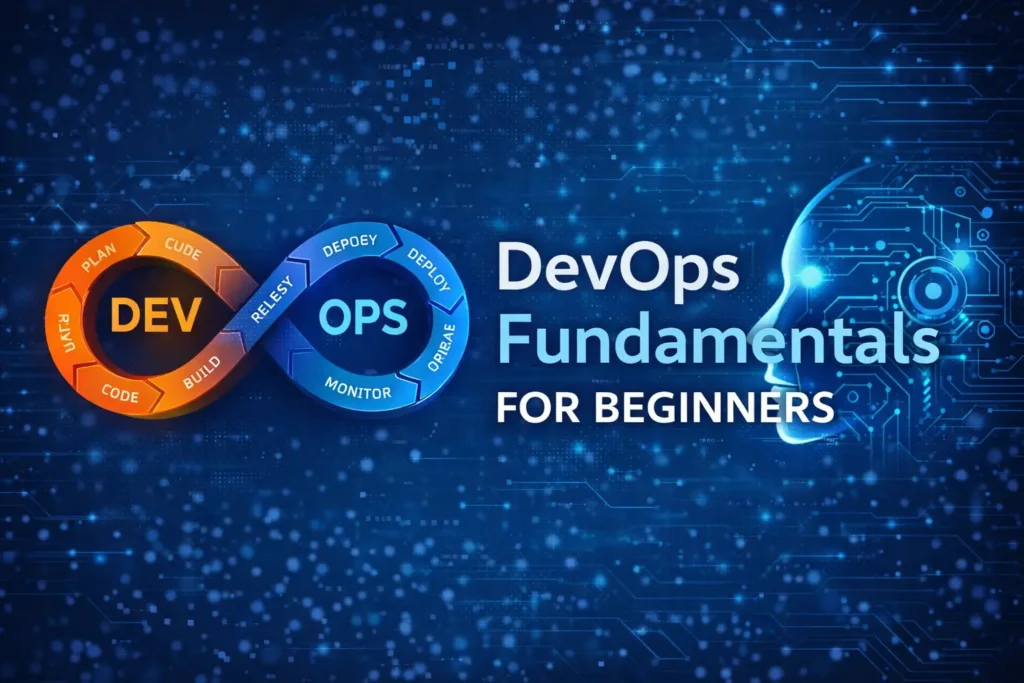
The DevOps lifecycle describes how software evolves from idea to operation and improvement.
Planning and Collaboration
Planning in DevOps is continuous and collaborative. Teams define requirements, prioritize work, and align on goals while considering operational impact.
Instead of large, fixed plans, DevOps encourages incremental planning that adapts to feedback and change.
Development and Code Management
Development in DevOps emphasizes:
- Small, frequent code changes
- Consistent coding standards
- Version control for all changes
Small changes reduce integration problems and make issues easier to identify and fix.
Integration and Automated Testing
Continuous integration ensures that code changes are integrated and tested frequently. Automated tests validate functionality, performance, and security early in the process.
Testing shifts left, meaning problems are caught closer to their source, where they are cheaper to fix.
Deployment and Release Management
DevOps treats deployments as routine operations rather than high-risk events. Automation ensures deployments are repeatable and predictable.
Modern DevOps teams use techniques such as:
- Incremental releases
- Rollbacks
- Controlled exposure to users
These practices reduce the impact of failures and increase confidence in releases.
Monitoring, Observability, and Feedback
Once software is deployed, monitoring becomes critical. DevOps teams track:
- System health
- Performance metrics
- Error rates
- User experience indicators
Observability provides visibility into how systems behave under real-world conditions. This data drives continuous improvement.
Key DevOps Practices Explained
Several practices are central to DevOps fundamentals.
Continuous Integration and Continuous Delivery
CI/CD pipelines automate the process of building, testing, and deploying software. This ensures that every change follows the same quality checks.
CI/CD reduces human error, speeds up feedback, and supports frequent releases without increasing risk.
Infrastructure as Code
Infrastructure as code treats infrastructure definitions the same way as application code. Environments are defined using configuration files that can be versioned and tested.
This approach improves consistency, scalability, and disaster recovery.
Monitoring and Incident Response
Monitoring is not just about detecting failures. It is about understanding system behavior.
DevOps teams design systems with observability in mind, enabling faster diagnosis and resolution of issues.
Security as a Shared Responsibility
DevOps increasingly integrates security practices into the delivery pipeline. Security checks are automated and treated as part of quality assurance.
This approach reduces late-stage security surprises and improves overall system resilience.
Common Misconceptions About DevOps
Many beginners misunderstand DevOps, leading to poor adoption.
DevOps is not:
- A single job role
- A specific toolchain
- A replacement for operations teams
- A guarantee of faster delivery without discipline
DevOps requires commitment, collaboration, and continuous learning.
DevOps for Small Teams and Large Organizations
DevOps is not limited to large enterprises. Small teams often benefit the most because they can adopt practices quickly.
For larger organizations, DevOps adoption requires cultural change, leadership support, and incremental implementation.
DevOps scales through principles, not rigid frameworks.
Skills Beginners Should Develop
Beginners should focus on understanding workflows rather than memorizing tools.
Important skills include:
- Understanding software delivery pipelines
- Version control fundamentals
- Basic system reliability concepts
- Communication and collaboration
Technical depth can be built over time, but foundational understanding is essential.
Why DevOps Fundamentals Matter Long-Term
Organizations often fail with DevOps because they skip fundamentals. They automate without redesigning processes. They adopt tools without changing culture.
Strong fundamentals enable:
- Sustainable delivery speed
- Resilient systems
- Better developer experience
- Improved customer satisfaction
DevOps is a long-term investment, not a quick fix.
Final Perspective
DevOps represents a fundamental shift in how software is built and operated. It aligns people, processes, and technology around shared responsibility and continuous improvement.
For beginners, mastering DevOps fundamentals is far more valuable than learning tools in isolation. Tools change quickly. Principles endure.
A strong foundation in DevOps fundamentals prepares individuals and organizations to build reliable, scalable software in an increasingly complex digital world.