May 16, 2026 | Enterprise AI Quality & Compliance Report
When OpenAI’s GPT-5 Failed Within 24 Hours
On January 12, 2026, OpenAI released GPT-5 to a limited group of enterprise customers. Within 24 hours, independent red teams had jailbroken the system. The researchers at security firm SPLX declared it “nearly unusable for enterprise out of the box.”
The finding wasn’t shocking to anyone watching the AI security landscape closely. But it did crystallize something critical: no large language model or AI system, regardless of development resources or safety focus, ships from the lab ready for enterprise deployment. Adversarial testing now precedes market deployment the way safety testing precedes pharmaceutical approvals. This is not optional. It is regulatory mandate, competitive requirement, and operational necessity.
By May 2026, red teaming has moved from security research curiosity to operational baseline. Organizations deploying AI systems without comprehensive adversarial testing face regulatory penalties, compliance failures, and reputational catastrophe. The EU AI Act enforcement date has shifted multiple times, but the requirement for red teaming of high-risk systems remains non-negotiable. The question enterprises face is not whether to red team, but how to do it comprehensively, continuously, and at scale.
The Technical Reality: Attack Success Rates That Demand Attention
The data on AI system vulnerability is difficult to overstate. Security researchers have documented attack methodologies with success rates that make traditional cybersecurity protocols look reassuring by comparison.
Roleplay attacks, where adversaries manipulate systems through fictional scenarios, achieve 89.6 percent success rates against large language models. Multi-turn jailbreaks, where attackers exploit the system over successive conversation turns, reach 97 percent success within five interactions. These are not theoretical vulnerabilities discovered in labs. They represent reproducible attack vectors that malicious actors can weaponize in minutes.
The distinction between known attack techniques and novel, organization-specific methodologies reveals an even more troubling gap. When red teamers at NIST developed novel attack techniques tailored to the specific behavioral patterns of LLM-backed agents, rather than relying on known baseline attack patterns, task-hijacking success rates rose from 11 percent to 81 percent. That is not a marginal improvement. It represents a complete inversion of what security posture actually protects against.
“What that research tells us is that a red team that runs the same tests everyone else runs and gets a score of 8 out of 10 provides false assurance,” said a security director at a major financial institution managing AI-powered risk scoring systems. “If an adversary invests in understanding your specific system, not just generic LLM vulnerabilities, they will likely find a way through. The gap between known vulnerabilities and unknown organizational attack surface is the vulnerability that matters most.”
This creates a fundamental testing challenge. Traditional security testing validates a system against a known threat taxonomy. AI red teaming must account for the possibility that novel attack methods, ones never documented before, can achieve dramatically higher success rates than conventional playbooks suggest.
Regulatory Mandate: From August 2026 Forward
The regulatory environment has transformed red teaming from an optional security practice to a compliance requirement with material financial consequences. On August 2, 2026, the EU AI Act entered full enforcement for high-risk AI systems. The regulation mandates adversarial testing before any high-risk AI system is placed on the market.
That deadline has been updated multiple times. Most recently, in May 2026, EU lawmakers reached political agreement on revisions that introduced some complexity and extended certain deadlines. However, the requirement for red teaming of general-purpose AI models with systemic risk remains binding. Providers must conduct adversarial testing before placement on the market, maintain documentation of those tests, and report serious incidents to the AI Office.
The penalty structure incentivizes compliance aggressively. Organizations that deploy high-risk AI systems without demonstrated red teaming face fines reaching 35 million EUR or 7 percent of global annual turnover, whichever is higher. For Microsoft, based on recent financials, that would equal approximately 16 billion USD. For Google, approximately 14 billion USD. These are not compliance costs absorbed as line items. They are board-level financial events that trigger immediate business impact.
But the regulatory mandate extends beyond financial penalties. National market surveillance authorities can order non-compliant AI systems withdrawn from the EU market entirely. They can mandate corrective actions, including model retraining, or prohibit the placement of new systems until compliance is demonstrated. For organizations with substantial EU customer bases, market withdrawal is not a theoretical risk. It is a real business outcome.
The United States has not yet passed comprehensive AI legislation matching the EU’s scope. However, the regulatory landscape is evolving rapidly. The Biden Administration’s October 2023 executive order on AI safety included provisions requiring red teaming. Federal AI procurement guidance increasingly references red teaming and adversarial testing as mandatory practices. The Federal Trade Commission has signaled that unfounded AI safety claims and inadequate security testing constitute deceptive business practices. Given that regulatory enforcement follows guidance, organizations should treat red teaming as mandatory regardless of their geographic location.
What Red Teaming Actually Is: Beyond Security Testing
Red teaming for AI is fundamentally different from traditional cybersecurity penetration testing or application security scanning. Those practices validate a system against a defined threat model. The attacker has specific objectives. The defender knows the vulnerability categories. Security testing can be largely automated.
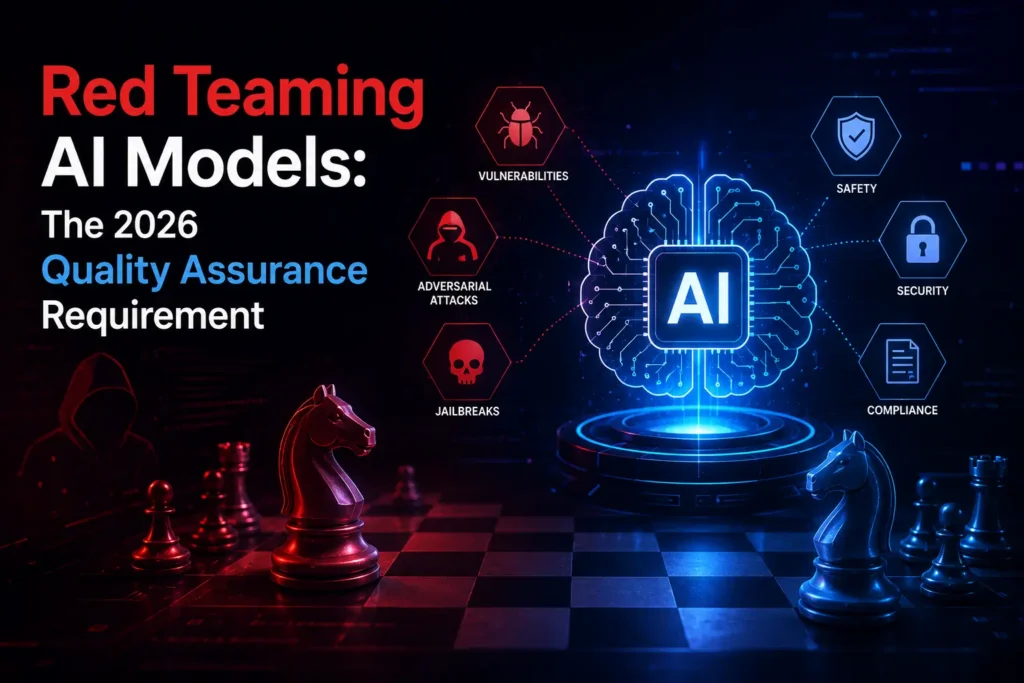
AI red teaming operates in a different paradigm. The objective is not to find SQL injection or buffer overflow vulnerabilities. It is to identify failure modes, safety gaps, and behavioral drift in probabilistic systems that operate differently on every interaction. The attack surface is not code. It is the model’s reasoning and decision-making architecture.
The OWASP Top 10 for Agentic Applications (published December 2025) codifies specific vulnerability categories that traditional security testing never anticipated. Agent behavior hijacking occurs when adversaries manipulate an AI agent into executing unintended actions. Tool misuse happens when agents invoke tools in ways that create unintended consequences. Identity and privilege abuse describes attacks where agents are tricked into operating with inappropriate authorization levels. These are not bugs in the code. They are architectural vulnerabilities in how agents reason about their environment and interpret their objectives.
Red teaming against these vulnerabilities requires a different skill set than traditional security. It requires people who understand how LLMs generate reasoning chains, how context windows create blindspots, how prompt injection works, and how to systematically identify failure modes across different input distributions. Some of this work can be automated. But the most effective red teaming combines automated discovery with expert human testers who understand the system’s specific implementation and can design novel attacks tailored to that system’s actual vulnerabilities.
The Enterprise Tooling Landscape: From Manual to Orchestrated
Organizations implementing red teaming programs in 2026 are working with a mature but still-evolving set of tools and frameworks. The landscape splits broadly into three categories: automated attack platforms, manual testing frameworks, and orchestration systems that integrate both.
Open-source tools have democratized baseline AI security testing. Microsoft’s PyRIT and NVIDIA’s Garak enable systematic AI red teaming at scale when combined with manual expert testing. These tools can generate adversarial prompts, test across multiple attack categories, and produce reportable results that feed into compliance documentation. They are not substitutes for domain expertise. But they enable security teams without AI-specific experience to conduct foundational adversarial testing.
Purpose-built commercial platforms like Zscaler’s AI Red Teaming service, Adversa AI, and others provide domain-specific adversarial testing that mirrors real organizational behavior. These platforms don’t just run the same tests every organization runs. They profile the specific system being tested, develop organization-context attack strategies, and integrate findings with compliance frameworks like NIST AI Risk Management Framework and the EU AI Act requirements.
The most effective enterprises are implementing layered approaches. Automated discovery identifies baseline vulnerabilities using tools like Garak. Manual expert red teaming, informed by industry-known attack vectors and organizational context, develops novel attack strategies specific to the deployed system. Continuous monitoring feeds production incidents and unexpected behaviors back into the red team process. Rather than treating red teaming as a pre-release gate, successful organizations treat it as continuous infrastructure.
“The biggest mistake I see is treating red teaming as a one-time checklist item,” said a CISO managing AI governance at a healthcare organization subject to FDA AI oversight. “We did our red teaming report in January, got it signed off, and felt secure. Then in March, researchers published a new attack technique against the type of model we were using. We hadn’t tested for it. Suddenly our signed-off compliance report was incomplete. Red teaming has to be continuous, not historical. It has to update as the threat landscape evolves.”
From Known Attacks to Organizational Vulnerabilities
The evolution from baseline vulnerability testing to organization-specific red teaming represents the actual frontier of AI security in 2026. Every LLM research team, every security firm, every red team publishes attack techniques. These techniques are documented, reproducible, and increasingly automated. An organization that red teams only against published attack categories gets the false assurance that they are safe from threats that exist in published literature.
The NIST research on LLM-backed agents demonstrates the severity of this gap. When defenses were optimized against known baseline attacks, systems performed well on those specific attacks. When red teamers developed novel techniques tailored to the specific system, success rates increased from marginal to dominant. This creates a testing paradox: the most important attacks are the ones you don’t know about yet.
Organizations addressing this challenge are implementing red teaming programs that include three components. First, baseline testing against known vulnerability categories. Second, organization-specific adversarial testing that profiles the system and develops attacks tailored to its actual implementation. Third, continuous refinement as new attack techniques are published and incorporated into testing playbooks.
This approach requires investment. Comprehensive red teaming for a complex AI system typically requires teams of specialists working over weeks or months. But that investment produces two critical outcomes. First, it identifies genuine vulnerabilities before they are exploited in production. Second, it provides documented evidence of diligent testing that satisfies regulatory requirements and defends against negligence claims if failures occur.
How Enterprises Are Structuring Red Teaming Programs
Organizations implementing enterprise-scale red teaming programs are converging on similar architectural patterns. The first requirement is inventory and classification. Before you can red team effectively, you must know what AI systems you have deployed. Many large organizations do not have complete inventories. Shadow AI, vendor solutions, and undocumented systems introduce blind spots.
Once AI systems are classified by risk level according to regulatory frameworks like EU AI Act Annex III or NIST categories, red teaming scope becomes clear. Not all systems require the same level of adversarial testing. Low-risk systems may require baseline automated testing. High-risk systems like those making personnel decisions, credit determinations, or healthcare recommendations require comprehensive expert red teaming.
The governance layer structures who is responsible for red teaming and how findings flow through the organization. Organizations are appointing AI security leads or establishing red team offices. These teams operate with independence from product teams to avoid conflicts of interest. A red team that reports to the product manager has incentive to downplay findings. A red team that reports to security leadership or a board-level AI committee maintains the objectivity necessary to identify real vulnerabilities.
The tooling layer integrates automated discovery, manual testing, and compliance documentation. Tools like PyRIT handle automated prompt injection testing and baseline vulnerability discovery. Expert red teamers conduct manual adversarial testing and develop organization-specific attack strategies. Findings feed into a centralized system that tracks vulnerabilities, maps to regulatory requirements, and monitors remediation.
The operational layer embeds red teaming into the development lifecycle, not as a gate before release but as continuous infrastructure. Every significant model update triggers red team assessment. Production monitoring feeds behavioral anomalies and security events back into the red team process. The objective is not a signed-off report dated July 31, 2026. The objective is sustained red teaming practices that continue indefinitely.
The Skills Gap: Hiring and Training Red Teamers
One of the most underestimated challenges in implementing enterprise red teaming programs is the skills gap. Traditional cybersecurity teams understand infrastructure testing, application penetration testing, and threat modeling. But AI red teaming requires understanding how LLMs generate reasoning, how to craft adversarial inputs that exploit specific model behaviors, and how to document findings in ways that satisfy both regulatory requirements and technical remediation teams.
The labor market for AI red teamers is extremely tight. Qualified practitioners are rare. Many are concentrated at frontier AI companies like OpenAI, Anthropic, and Google that can offer compensation and access to cutting-edge systems that small teams cannot match. Enterprises are addressing this gap through a combination of hiring, training, and outsourcing.
Some organizations are hiring researchers from the academic AI safety space or recruiting experienced security engineers and investing in AI-focused training. Others are building partnerships with specialized red teaming firms that provide access to expert practitioners. The most effective approach appears to be hybrid: internal red team leads who understand the organization’s systems and external specialists who bring cutting-edge adversarial research and novel attack techniques.
The role of AI red teamer has emerged as a distinct career path. Practitioners in this space combine deep machine learning knowledge with adversarial research skills and security mindset. They typically come from either AI research backgrounds that developed security focus or cybersecurity backgrounds that developed AI expertise. The convergence of these two skill domains is rare, making practitioners highly valued.
Production Monitoring: When Red Teaming Continues After Release
A significant shift in how enterprises approach AI security in 2026 is the understanding that red teaming does not end at release. Production behavior, user interactions, and system outputs provide critical signals that inform ongoing adversarial testing.
Organizations are implementing telemetry systems that log unusual model outputs, unexpected behaviors, and signs of potential attacks. When a system refuses a request that it should handle, or produces output that violates expected boundaries, that incident becomes a signal that a new attack technique may have been discovered or a new vulnerability may exist. Rather than treating that as an isolated customer support issue, it feeds back into the red team process.
This production-informed red teaming is particularly valuable for detecting attacks that only manifest under specific conditions. A model might be vulnerable to prompt injection only when processing certain types of input, or only when certain context has been established. Lab testing may not discover these conditional vulnerabilities. But production traffic, which exposes the system to millions of diverse input combinations, will reveal them.
The feedback loop from production to red teaming team to remediation team creates what amounts to continuous improvement in security posture. Rather than treating a released model as static, organizations treat it as a system that will be attacked in novel ways, will reveal new vulnerabilities through production signals, and will require iterative hardening.
Looking Ahead: The Regulatory and Technical Frontier
Red teaming has moved from experimental security practice to mandatory compliance requirement within a remarkably short timeframe. Organizations that invested in red teaming capabilities in 2024 and 2025 are now positioned to meet 2026 regulatory deadlines. Those starting now face a compressed timeline.
But the technical frontier in red teaming is also advancing rapidly. Autonomous red teaming agents that can systematically discover vulnerabilities without human direction are emerging. Novel attack techniques are being published regularly. The threat landscape for AI systems is evolving faster than the defensive capability of many organizations.
The organizations that will maintain security posture in this environment are those that treat red teaming as permanent infrastructure, not a compliance project. They maintain continuous red team operations. They invest in recruiting and developing expertise. They integrate red teaming findings into design decisions and governance frameworks. They monitor production systems relentlessly for new attack signals.
Regulatory enforcement is now underway. National authorities in the EU have the power to demand demonstrable red teaming evidence, pull non-compliant systems from the market, and levy penalties reaching billions of dollars. In the United States, regulatory guidance from NIST, the Federal Trade Commission, and federal AI procurement officers increasingly references red teaming as mandatory. The landscape has shifted from optional to obligatory in remarkably short order.
Key Metrics on AI Red Teaming in 2026
- 89.6 percent success rate for roleplay attacks against LLMs
- 97 percent success rate for multi-turn jailbreaks within 5 conversation turns
- 81 percent vs 11 percent: task-hijacking success when using novel vs baseline attacks
- 24 hours: time to jailbreak GPT-5 after release
- 35 million EUR or 7 percent global revenue: maximum EU AI Act penalties for non-compliance with red teaming requirements
- 100 percent of surveyed organizations plan to expand AI agent adoption in 2026
- 88 percent of organizations already use AI in at least one business function
The transformation is complete. Red teaming is no longer a security best practice being debated in conference presentations. It is a regulatory requirement, a competitive necessity, and the operational baseline that determines whether enterprises can deploy AI systems safely and legally.