May 16, 2026 | Global Tech Industry Report
The Testing Crisis That AI Just Solved
For decades, software testing teams have been trapped in a cycle that nobody talks about openly: the selector maintenance nightmare. A developer renames a CSS class. A component library gets updated. Suddenly, 30 percent of your test suite fails, not because the application is broken, but because tests were brittle by design. The engineers spend weeks rebuilding test selectors instead of building features.
This was the unspoken tax of traditional test automation. It consumed thousands of engineering hours annually across the industry.
By May 2026, that problem is becoming obsolete.
The software testing landscape has undergone a structural transformation that goes far beyond incremental improvement. The shift from record-and-replay test automation to autonomous AI agents represents a fundamental reimagining of how quality assurance integrates into the development lifecycle. What began as experimental technology in 2024 has matured into production-grade infrastructure that major enterprises now depend on daily.
“We’re not just automating tests faster anymore,” said an engineering leader at a Fortune 500 financial services firm. “We’re rethinking the entire relationship between code changes and quality validation. Autonomous agents learn how our application actually behaves, then adapt when things change. We’ve gone from fighting test maintenance as a full-time job to treating testing as infrastructure that fixes itself.”
The Technical Shift: From Record-and-Replay to Autonomous Discovery
The old paradigm had a fundamental limitation that nobody could overcome. A tester would manually walk through an application, recording clicks and form entries. The tool would capture those steps, and those steps became a test. The problem was immediate: the resulting tests were fragile because they were tied to implementation details that changed constantly.
The new generation of AI testing tools operates on a completely different principle. Instead of recording human actions, these platforms autonomously crawl applications, discovering every page, every interactive element, and every state transition. They generate test cases from what they discover, building tests on semantic selectors rather than brittle CSS class names.
This distinction matters more than it might initially appear. A semantic selector targets a button by its accessible role and label, not by div.btn-primary-v2. When a developer refactors styles or updates component libraries, the test survives. It keeps running while the team ships features. The maintenance burden that consumed 40 to 60 percent of QA engineering time in 2015 has been reduced to near zero for leading organizations.
Current adoption data shows the magnitude of this shift. In 2026, 79 percent of enterprises have adopted some form of AI agents, and 100 percent of surveyed organizations plan to expand that adoption this year, according to data from major enterprise software vendors. More specifically for testing and quality assurance, approximately 32.8 percent of survey respondents indicated they use AI-assisted functional testing to assess both traditional features and AI-generated code capabilities.
Autonomous Agents: The Missing Piece
Autonomous testing agents represent a qualitative leap beyond traditional AI-powered automation. These aren’t simple tools that record steps or follow rigid decision trees. They are self-directed systems that can analyze application behavior, identify high-risk areas independently, and dynamically adjust test coverage without human direction at every stage.
The practical implication is significant: testing now runs continuously without dedicated automation engineers managing every pipeline orchestration. The system escalates issues only when thresholds of uncertainty or risk are exceeded. Attention gets reserved for problems that actually matter.
This shift has been accelerated by advances in how AI systems handle multi-step workflows. Earlier generations of AI agents suffered from error accumulation in complex processes. A mistake in step two would cascade through steps three, four, and five, making multi-step automation unreliable at scale. By May 2026, self-verification mechanisms have become standard. AI agents now equipped with internal feedback loops can autonomously verify their own work and correct mistakes without requiring human oversight for every action.
“Self-verification is the breakthrough that made agentic testing viable for enterprise workflows,” explained a principal engineer at a major SaaS company. “Our agents can now handle complex, multi-hop testing scenarios that would require multiple human testers reviewing each step. The error rates have dropped dramatically because the system double-checks itself continuously.”
The Real-World Impact on Development Velocity
Organizations that have integrated autonomous testing agents into their CI/CD pipelines report measurable changes in how they operate. Release cycles have compressed further. Quality insights arrive faster. The friction between development velocity and test coverage has been reduced significantly.
One manufacturing technology company reduced test maintenance costs by 65 percent within six months of deploying autonomous AI testing. A digital health platform scaled test coverage across mobile, web, and API layers without increasing QA headcount. An e-commerce organization reduced the time to identify and reproduce defects from days to hours by feeding production behavior data back into their autonomous testing systems.
What these organizations share is a common architecture: they treat testing as continuous infrastructure rather than a gate before release. Tests run automatically on every commit. Autonomous agents discover edge cases in staging environments. Production logs, real user telemetry, and performance metrics feed back into the testing system, creating closed-loop quality intelligence.
This approach also shifts the nature of what gets tested. In 2026, testing scope has expanded well beyond functional validation. Organizations now validate performance across real network conditions, security posture through continuous scanning, accessibility compliance automatically, and the consistency of AI-generated code. For applications that include AI features, testing frameworks must now verify non-deterministic behavior rather than expecting fixed outputs.
The Regulatory Inflection Point
An important context for this evolution is regulatory. May 2026 marks an accelerated push by governments, especially the United States, toward testing AI models before public release. Major AI companies including Microsoft, OpenAI, Google, and Anthropic have reportedly agreed to provide early access to regulators for model evaluation and safety testing. This is a transformative moment: AI is transitioning from a “move fast and break things” environment toward regulated testing similar to finance or pharmaceuticals.
This regulatory shift amplifies the business case for autonomous testing. Organizations that can demonstrate comprehensive, continuous quality assurance have significant competitive and regulatory advantages. Autonomous agents provide the scale and consistency that regulators increasingly expect.
The Skills Transformation
The transformation has profound implications for testing professionals. The role is not disappearing, but it is evolving fundamentally.
QA professionals are shifting from execution-focused testers who hand-craft test scripts to quality architects who design testing strategy, interpret quality analytics, and collaborate closely with development, product, and operations teams. The skills required for this new role are markedly different.
Understanding AI-driven test generation, working with predictive quality analytics, designing risk-based testing approaches, and managing low-code or no-code automation tools have become essential. The ability to clearly specify what needs to be tested and why has become more important than the ability to write test code.
Organizations report that this transition creates an interesting dynamic. Entry-level automation engineers who could follow patterns and write scripts face displacement. Senior testing architects who understand testing strategy, risk assessment, and quality engineering move into more valuable roles. The middle layer shrinks because the automation handles routine execution.
Production as the New Source of Truth
Another significant shift in 2026 is the increased importance of production behavior as a quality signal. The boundary between pre-release testing and production monitoring has blurred substantially.
Organizations increasingly adopt both “shift-left” and “shift-right” strategies. On the left side, testing begins during design. Requirements are checked for gaps. Unit and API tests are suggested automatically. Static analysis runs continuously during development. On the right side, production behavior becomes a critical input for quality engineering. Real user interactions, performance metrics, and incident patterns are fed back into QA systems automatically. Failures observed in production are converted into new test cases. Performance or reliability issues become triggers for targeted regression testing.
This approach is particularly valuable for distributed, cloud-native systems where issues are difficult to reproduce in test environments. The most critical defects in 2026 are often environment-specific, integration-related, or observable only under real load. Organizations that can convert production insights into automated tests achieve faster mean time to recovery and prevent reoccurrence of the same failures.
Looking Ahead: The 2026 Testing Landscape
The software testing market is projected to reach approximately 99.79 billion USD by 2035, according to industry projections. Within that market, the subset representing AI-driven autonomous testing is expanding at rates exceeding 35 percent annually. This growth is driven not by marketing hype but by measurable improvements in delivery velocity, cost reduction, and quality metrics.
Several key trends will shape the remainder of 2026 and beyond. Context windows for AI agents will expand, giving them improved working memory to learn from past actions and pursue complex long-term goals. Context and persistent memory will become the constraint that determines what autonomous agents can achieve. Multi-agent collaboration will mature, with systems capable of communicating, negotiating, and working together toward shared objectives. Governance will become more sophisticated as organizations integrate autonomous testing into regulated industries and security-sensitive environments.
The question facing CIOs and engineering leaders is no longer whether autonomous testing agents will transform quality assurance. The evidence is clear: they already are. The question is whether organizations will lead this transformation or follow. The organizations that are setting up autonomous testing infrastructure today will have measurable advantages in velocity, quality, and cost structure by the end of 2026. Those that delay will face increasing pressure to justify traditional QA models when alternatives demonstrably outperform them.
Key Metrics from 2026 Testing Transformation
- 79 percent of enterprises have adopted some form of AI agents
- 32.8 percent of organizations use AI-assisted functional testing
- 65 percent average reduction in test maintenance costs (early adopters)
- 40 to 60 percent of historical QA time spent on test maintenance (now reduced)
- 99.79 billion USD projected global testing market size by 2035
- 35+ percent annual growth rate for AI-driven autonomous testing segment
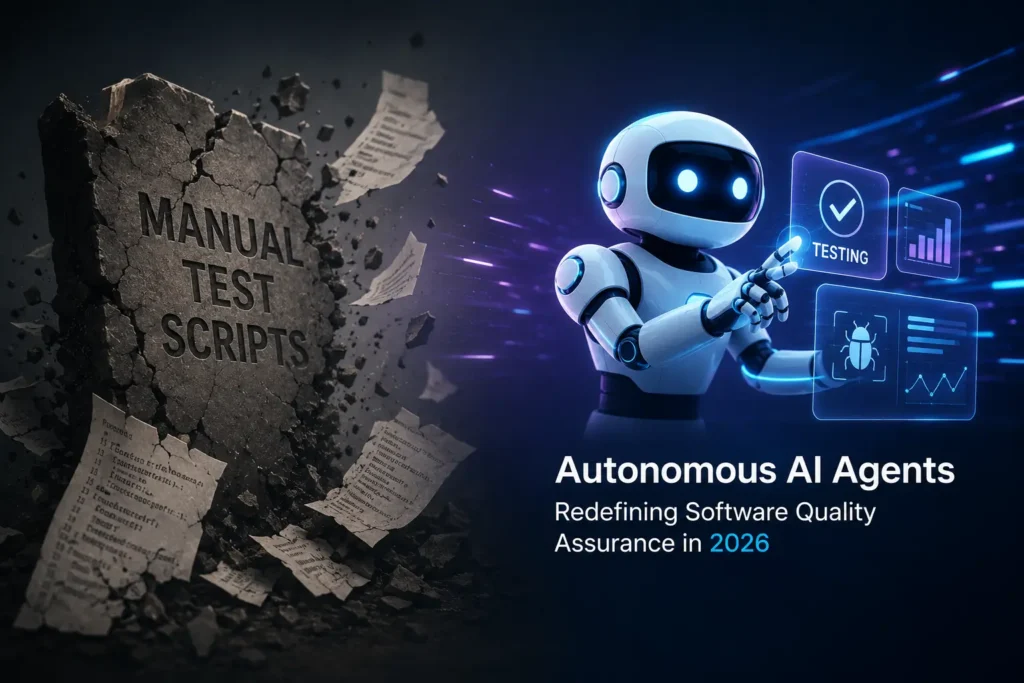
The transformation that seemed speculative in 2023 is now operational reality in 2026. The death of manual test scripts is not a future prediction. It is happening now, and the organizations adapting fastest are already seeing the competitive advantages this creates.