AI in DevOps is no longer an experimental concept discussed only in innovation labs or early-stage engineering communities. In 2026, it has become a defining operational priority for enterprises attempting to manage increasingly complex software delivery ecosystems. Traditional DevOps automation models helped organizations accelerate deployments, standardize infrastructure provisioning, and improve collaboration between development and operations teams. However, the scale of modern digital environments has exposed the limitations of rule-based operational engineering.
Enterprise systems today operate across multi-cloud architectures, Kubernetes environments, distributed APIs, AI-driven applications, edge computing infrastructure, and real-time service ecosystems that generate massive volumes of operational telemetry every second. Human teams alone cannot effectively interpret this complexity fast enough to maintain resilience, optimize performance, reduce downtime, and sustain delivery velocity.
Artificial intelligence is emerging as the intelligence layer of modern DevOps. AI systems are increasingly being integrated into CI/CD pipelines, observability platforms, infrastructure operations, incident management workflows, security systems, release engineering, and platform engineering environments. The objective is no longer simply automation. The objective is intelligent operational decision-making at scale.
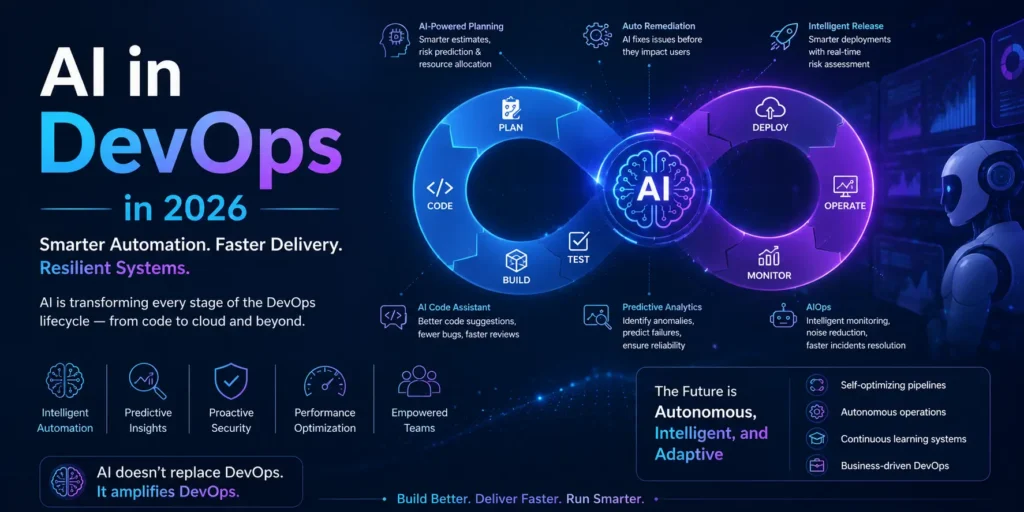
This transformation is reshaping how enterprises think about software delivery, operational resilience, engineering productivity, and infrastructure governance. Organizations are moving beyond reactive operational models toward predictive and autonomous operational ecosystems capable of identifying anomalies, forecasting risks, optimizing deployments, reducing alert noise, and assisting engineers with operational decision-making in real time.
At the same time, AI-powered DevOps introduces new concerns involving governance, explainability, operational trust, security, compliance, and over-automation. The organizations that succeed in the next generation of DevOps will not necessarily be those with the fastest pipelines. They will be the organizations capable of balancing intelligent automation with human oversight, operational governance, and engineering accountability.
The future of DevOps is not simply automated infrastructure. The future is intelligent engineering operations.
Why Traditional DevOps Models Are Reaching Their Limits
For more than a decade, DevOps transformed enterprise software delivery by breaking down barriers between development and operations teams. Continuous integration, continuous deployment, Infrastructure as Code, cloud-native engineering, and automation-first operational strategies helped enterprises accelerate innovation at unprecedented scale. What once required weeks of coordination could now be accomplished in minutes through automated pipelines and infrastructure orchestration.
However, the operational conditions surrounding modern software delivery have changed dramatically. Engineering ecosystems have become significantly more distributed, interconnected, and data-intensive than the environments DevOps practices originally evolved to support.
Traditional DevOps models were largely designed around automating predictable workflows. In 2026, predictability itself is becoming increasingly difficult to maintain. Modern enterprise systems consist of thousands of interconnected services operating across hybrid infrastructure environments where deployment frequency, runtime variability, and infrastructure dynamism continuously increase operational complexity.
Microservices architectures are one of the biggest drivers behind this transformation. Earlier enterprise systems often revolved around centralized monolithic applications with relatively stable dependencies. Modern applications now rely on highly fragmented service ecosystems where a single customer interaction may traverse dozens of APIs, cloud functions, data pipelines, authentication systems, container clusters, and third-party integrations. While microservices improve scalability and deployment flexibility, they also create operational sprawl that is difficult to monitor and manage effectively.
The problem becomes even more significant in multi-cloud environments. Enterprises rarely depend on a single infrastructure provider anymore. Many organizations simultaneously operate workloads across Amazon Web Services, Microsoft Azure, Google Cloud, private cloud infrastructure, SaaS operational systems, and edge environments. Each platform introduces unique tooling, security policies, networking models, observability standards, and operational dependencies. Maintaining consistency across these environments places enormous pressure on DevOps teams.
Kubernetes has further amplified operational complexity. Container orchestration provides scalability and deployment flexibility, but enterprise Kubernetes environments generate huge volumes of telemetry and infrastructure changes continuously. Clusters scale dynamically, workloads shift automatically, services appear and disappear rapidly, and infrastructure states change constantly. Human operators struggle to manually analyze operational patterns in environments evolving at machine speed.
At the same time, deployment frequency continues accelerating. Many organizations now deploy software dozens or even hundreds of times per day. Continuous delivery pipelines have improved release velocity, but they have also increased operational risk. Every deployment introduces the possibility of infrastructure conflicts, performance regressions, security vulnerabilities, or cascading service failures. Traditional automation pipelines execute tasks efficiently, but they often lack the intelligence required to evaluate contextual operational risk.
This growing complexity creates enormous operational burden on engineering teams. Alert fatigue has become one of the most serious operational challenges inside enterprise DevOps environments. Modern observability systems generate overwhelming volumes of notifications related to latency spikes, infrastructure anomalies, deployment failures, dependency disruptions, security events, and application instability. Engineers frequently struggle to distinguish meaningful incidents from operational noise.
Pipeline instability also remains a major concern. CI/CD systems themselves have become highly complex operational platforms. Build failures, flaky test environments, configuration conflicts, dependency mismatches, and infrastructure inconsistencies can destabilize release workflows and reduce delivery confidence. Traditional monitoring systems often detect symptoms without understanding root causes or broader system relationships.
Infrastructure drift adds another layer of operational difficulty. Despite Infrastructure as Code adoption, many enterprise environments gradually diverge from intended configurations because of emergency changes, inconsistent updates, manual interventions, or undocumented modifications. Over time, operational consistency deteriorates, increasing the likelihood of outages and compliance failures.
As these pressures grow, enterprises are realizing that automation alone is no longer sufficient. DevOps environments now require systems capable of interpreting operational signals, predicting failures, understanding dependencies, prioritizing incidents, and assisting with decision-making at scale. This is the operational gap AI is beginning to fill.
What AI in DevOps Actually Means
The phrase AI in DevOps is often used loosely across the technology industry, but its meaning extends far beyond adding machine learning features to existing operational tools. In practical enterprise environments, AI in DevOps represents the integration of intelligent systems into software delivery and infrastructure operations to improve decision-making, operational efficiency, reliability, and resilience.
Traditional DevOps automation follows predefined instructions. Pipelines execute scripted workflows, monitoring systems trigger alerts based on static thresholds, and infrastructure provisioning tools apply deterministic configurations. These systems automate execution, but they do not inherently understand operational context or adapt dynamically to changing conditions.
AI introduces adaptive intelligence into operational engineering. Instead of simply executing predefined workflows, AI systems analyze operational telemetry, identify patterns, detect anomalies, forecast risk, and assist engineers with complex operational decisions.
Machine learning models can analyze historical deployment data to predict which releases are likely to fail. Generative AI systems can assist engineers with infrastructure scripting, documentation generation, and troubleshooting workflows. Predictive analytics engines can identify early warning signs of system instability before outages occur. Agentic AI systems can coordinate operational workflows autonomously across observability, incident management, deployment orchestration, and infrastructure remediation environments.
The evolution from automation to operational intelligence is fundamentally changing DevOps operating models. Earlier automation systems focused on reducing repetitive manual tasks. AI systems focus on augmenting human operational reasoning.
This distinction is important because modern infrastructure environments generate more operational data than human teams can reasonably process in real time. AI is becoming valuable not because it replaces engineers, but because it helps engineering organizations manage operational complexity at enterprise scale.
Core Areas Where AI Is Transforming DevOps
One of the most visible applications of AI in DevOps is inside CI/CD pipelines. Traditional pipelines automate build execution, testing workflows, deployment sequencing, and release orchestration. AI-enhanced pipelines add contextual intelligence to these processes.
Modern AI-powered pipelines can analyze historical deployment data to identify patterns associated with unstable releases. Instead of relying solely on static validation checks, intelligent deployment systems evaluate operational risk dynamically. These systems may analyze infrastructure dependencies, code changes, historical defect trends, performance telemetry, and runtime anomalies before recommending whether a deployment should proceed.
Predictive deployment analysis is becoming especially important in large enterprise environments where release failures can affect millions of users or critical business operations. AI systems help organizations move from reactive deployment management toward proactive release intelligence.
AIOps has emerged as another major area of transformation. AIOps platforms use machine learning and operational analytics to improve observability, incident management, and infrastructure monitoring. Traditional monitoring systems often overwhelm engineers with disconnected alerts that lack contextual prioritization. AIOps systems correlate events across distributed environments to identify meaningful operational relationships.
For example, a latency spike in one service may trigger multiple downstream alerts across dependent systems. Traditional monitoring tools may treat these as unrelated incidents. AI-powered operational intelligence platforms can recognize the dependency chain, identify probable root causes, and reduce operational noise significantly.
AI-driven observability is also becoming central to modern DevOps ecosystems. Enterprise systems now generate enormous telemetry volumes across logs, traces, metrics, APIs, containers, cloud infrastructure, and application services. Human teams cannot manually interpret these signals effectively at scale.
AI-assisted observability systems analyze telemetry continuously to detect anomalies, correlate dependencies, identify hidden patterns, and prioritize operational risks. Instead of simply displaying dashboards, observability platforms are evolving into intelligent operational advisors.
Predictive incident management represents another major shift. Traditional operational workflows are reactive by nature. Teams typically respond after failures occur. AI systems enable organizations to anticipate incidents before they escalate into outages.
By analyzing historical failure patterns, infrastructure telemetry, deployment histories, and runtime anomalies, predictive systems can forecast operational instability and recommend preventive actions. This shift toward predictive operations is helping enterprises reduce downtime and improve resilience.
Self-healing infrastructure is also gaining momentum. In earlier DevOps environments, remediation typically required manual intervention. AI-powered operational systems can now trigger automated remediation workflows for common infrastructure issues. Kubernetes clusters may automatically restart unstable workloads, scale resources dynamically, isolate problematic services, or roll back risky deployments based on AI-driven operational analysis.
The rise of AI-assisted Infrastructure as Code management is similarly important. AI systems can analyze infrastructure templates to detect security risks, policy violations, configuration inconsistencies, and operational inefficiencies before deployments occur. This improves infrastructure governance while reducing operational errors.
Release engineering is also evolving rapidly. Modern enterprises deploy software continuously, but release confidence remains a major concern. AI-powered release intelligence systems analyze deployment risk using telemetry from testing environments, observability platforms, historical incidents, and infrastructure dependencies. These systems help engineering leaders make more informed deployment decisions with greater operational confidence.
How Generative AI Is Changing DevOps Engineering
Generative AI has become one of the most disruptive forces in modern engineering operations. Large language models are transforming how DevOps engineers interact with infrastructure, deployment systems, observability platforms, and operational workflows.
AI copilots are increasingly integrated into engineering environments to assist with scripting, troubleshooting, infrastructure configuration, documentation generation, and operational analysis. Instead of manually writing complex deployment templates or Kubernetes manifests, engineers can use natural language prompts to generate infrastructure code rapidly.
This capability significantly accelerates operational workflows, especially for repetitive engineering tasks. However, the value of generative AI extends beyond productivity gains. AI systems are also helping reduce knowledge fragmentation inside large engineering organizations.
Many DevOps environments rely heavily on tribal operational knowledge distributed across different teams. Generative AI systems can help centralize operational intelligence by generating runbooks, summarizing incidents, documenting remediation procedures, and assisting engineers during troubleshooting workflows.
Natural language operational interfaces are becoming increasingly common. Engineers can interact with observability systems, deployment pipelines, and infrastructure environments conversationally rather than relying entirely on command-line operations or fragmented dashboards.
At the same time, generative AI introduces significant operational risks. AI-generated infrastructure scripts may contain security vulnerabilities, configuration errors, or inefficient operational logic. Hallucinated outputs remain a serious concern, especially in environments where incorrect infrastructure actions could affect production systems.
As a result, enterprises are increasingly adopting human-in-the-loop governance models where AI-generated operational actions require validation before execution.
The Rise of Autonomous DevOps Systems
The long-term direction of AI in DevOps is moving toward autonomous operational ecosystems. Autonomous DevOps refers to operational environments where AI systems can monitor infrastructure, identify risks, coordinate remediation workflows, optimize deployments, and assist with operational decision-making with limited human intervention.
Agentic AI systems are central to this transformation. Unlike earlier automation tools that execute predefined scripts, agentic systems can reason across operational objectives, analyze dynamic environments, coordinate workflows, and adapt to changing operational conditions.
Infrastructure agents may monitor Kubernetes environments continuously and optimize workload placement automatically. Incident response agents may correlate telemetry, identify root causes, and initiate remediation procedures before engineers become involved. Deployment agents may evaluate release risk and recommend deployment strategies dynamically.
This does not mean DevOps engineers will disappear. In fact, human oversight becomes even more important as operational systems become more autonomous. Enterprises cannot afford fully opaque operational environments where AI systems make critical infrastructure decisions without governance or accountability.
Human-in-the-loop operational governance is therefore becoming essential. AI systems may recommend actions, but engineers remain responsible for validating operational trustworthiness, risk exposure, compliance alignment, and strategic decision-making.
Platform Engineering and AI-Native Operations
Platform engineering has emerged as one of the most important operational shifts in enterprise technology. As DevOps complexity increases, organizations are creating centralized engineering platforms that standardize infrastructure operations, improve developer experience, and simplify operational workflows.
AI is accelerating this transformation significantly.
Internal developer platforms are increasingly integrating AI-powered operational intelligence to automate infrastructure provisioning, optimize deployment workflows, improve observability, and guide engineering teams through standardized operational patterns.
Developer experience is becoming a strategic operational priority. Engineering productivity depends heavily on reducing operational friction. AI-powered platforms help simplify infrastructure interactions by automating repetitive workflows, reducing configuration complexity, and improving operational discoverability.
This convergence between AI, platform engineering, and DevOps is shaping the future of AI-native operational ecosystems.
Enterprise Adoption of AI in DevOps
Large technology companies are already investing heavily in AI-driven operational engineering. Google has long integrated machine learning into infrastructure optimization and operational monitoring. Microsoft is embedding AI capabilities across cloud operations and developer platforms. Amazon continues expanding AI-powered operational services inside AWS ecosystems. IBM remains heavily focused on AIOps and enterprise operational intelligence.
Beyond technology companies, industries including banking, healthcare, telecommunications, retail, and SaaS are increasingly adopting AI-powered operational systems to improve reliability, scalability, and delivery velocity.
Financial institutions are using AI-driven observability to improve operational resilience and reduce downtime in mission-critical environments. Healthcare organizations are leveraging predictive infrastructure analytics to improve application availability for patient-facing systems. Retail platforms rely heavily on AI-assisted scalability management during high-demand events.
The adoption trend is accelerating because operational complexity continues growing faster than traditional engineering models can handle.
The Business Impact of AI in DevOps
The business implications of AI-driven DevOps extend beyond operational efficiency. AI is becoming a strategic capability for organizations competing in increasingly digital markets.
Faster deployment cycles enable enterprises to respond more quickly to market demands. Improved observability reduces downtime and improves customer experience. Predictive operational intelligence helps reduce costly outages and infrastructure instability. AI-assisted operational workflows improve engineering productivity while lowering operational overhead.
Release confidence is also improving. Enterprises can deploy software more aggressively when operational intelligence systems provide better visibility into deployment risk and infrastructure health.
These improvements directly influence revenue, customer retention, operational resilience, and digital competitiveness.
Major Risks and Challenges of AI-Driven DevOps
Despite its benefits, AI-powered DevOps introduces serious risks that enterprises cannot ignore.
One major concern is over-automation. AI systems may recommend or execute operational actions based on incomplete context, flawed models, or inaccurate telemetry. Incorrect automated decisions can rapidly escalate operational instability.
Generative AI hallucinations represent another serious challenge. AI-generated infrastructure code or remediation recommendations may appear technically correct while containing hidden operational or security risks.
Model drift also affects operational reliability. AI systems trained on historical operational patterns may become less accurate as infrastructure environments evolve. Continuous validation and governance are therefore essential.
Security risks are particularly important. AI-generated infrastructure templates, deployment scripts, or operational workflows may introduce vulnerabilities if not properly reviewed. Enterprises must ensure AI systems align with security policies, compliance requirements, and operational governance frameworks.
Operational trust is another critical issue. Engineers must understand why AI systems make certain recommendations. Black-box operational intelligence systems create governance and accountability concerns, especially in highly regulated industries.
AI Governance and Responsible Operational Engineering
Governance is becoming one of the defining themes of AI-powered DevOps in 2026. Enterprises are recognizing that intelligent operational systems require strong oversight frameworks to ensure reliability, accountability, and trustworthiness.
Responsible operational AI requires explainability, auditability, policy enforcement, and human oversight. Organizations must establish governance models defining:
- where AI can operate autonomously
- where human approval is required
- how operational decisions are validated
- how AI recommendations are audited
- how risk exposure is monitored
AI governance in DevOps is not just about compliance. It is fundamentally about operational resilience and trust.
The Expanding Role of the Modern DevOps Engineer
The role of the DevOps engineer is evolving rapidly. Earlier DevOps environments focused heavily on scripting, deployment automation, infrastructure provisioning, and CI/CD management. Modern DevOps engineers increasingly operate as intelligence-driven operational architects.
Engineers now require expertise in:
- AI-assisted operations
- observability analysis
- platform engineering
- operational governance
- cloud-native architecture
- intelligent automation systems
Human judgment remains critical. AI systems may provide recommendations and operational insights, but engineers remain responsible for strategic oversight, risk evaluation, architecture decisions, and operational accountability.
The future DevOps engineer is not simply an automation specialist. The future DevOps engineer is an operational intelligence professional.
The Future of DevOps Beyond 2026
The future of DevOps is moving toward intelligent operational ecosystems where observability, automation, platform engineering, security, and AI operate as interconnected systems.
Operational environments will become increasingly autonomous, predictive, and adaptive. Infrastructure platforms will optimize themselves dynamically based on workload behavior, telemetry analysis, and operational objectives. Incident management systems will predict failures before outages occur. Deployment pipelines will continuously evaluate risk using real-time operational intelligence.
At the same time, the need for governance, explainability, and human oversight will grow substantially.
Fully autonomous operations may eventually become technically feasible in certain environments, but enterprise organizations will continue requiring human accountability for strategic operational decisions.
The most successful organizations in the next generation of DevOps will not simply automate infrastructure faster. They will build intelligent operational ecosystems capable of balancing AI-driven efficiency with governance, resilience, security, and trust.
Final Thoughts
DevOps in 2026 is no longer defined solely by automation, CI/CD pipelines, or cloud-native infrastructure. The discipline is evolving into intelligent operational engineering powered by AI-driven decision-making, predictive analytics, observability intelligence, and autonomous operational systems.
This transformation is being driven by necessity. Enterprise systems have become too complex, too distributed, and too dynamic for traditional operational models to manage efficiently at scale.
AI is becoming the operational intelligence layer that helps organizations interpret complexity, improve resilience, accelerate delivery, and reduce operational risk. However, the future of AI-powered DevOps will depend heavily on governance, accountability, and human oversight.
The organizations that succeed will not be those that automate blindly. They will be the organizations that combine intelligent operational systems with disciplined engineering governance and strategic operational leadership.
The future of DevOps is not just automated infrastructure.
It is intelligent operations at enterprise scale.